
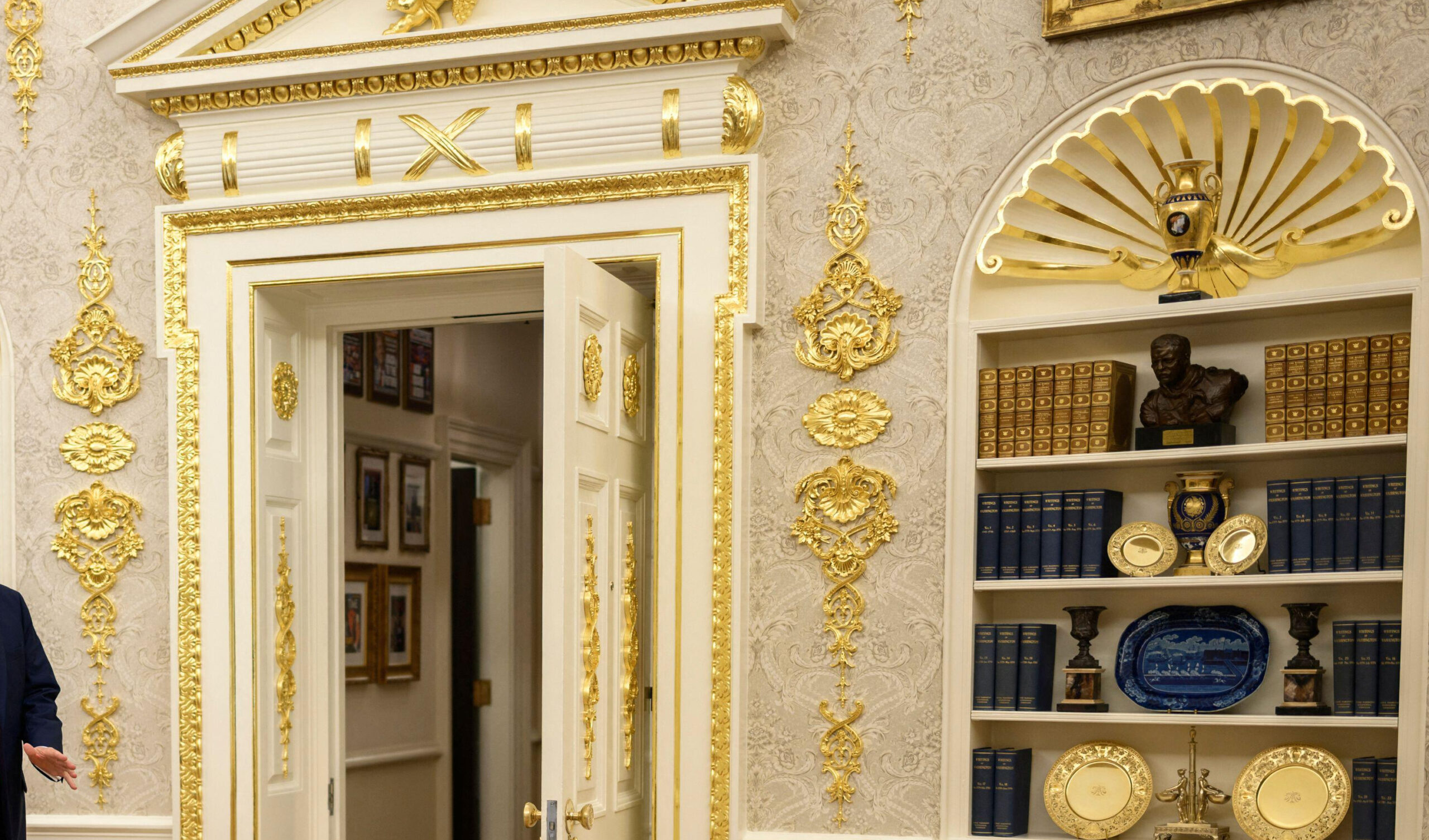
Geopix/Alamy
“Perhaps, after all, America never has been discovered,” said Mr. Erskine. “I myself would say that it had merely been detected.”
—Oscar Wilde, The Picture of Dorian Gray[1]
Prior to the arrival within its storied circumference of the effulgent portfolio of pathologies bound up in the decreasingly resilient skin of Donald Trump, the symbolic power of the postwar Oval Office relied in part on an oppositional quality.
Existing at once inside of and walled off from the America it guided, the Oval Office in the age of postwar televised politics had served to signify an essence, to throw into stark relief the contrast between the monastic meditations required to keep America on its course and the ephemeral din daily emanating from its worldly circus.
The investor Warren Buffet has popularized the concept of “moats” when valuing companies. Figurative moats don’t necessarily prevent companies and brands from being attacked through competition, but they do insulate them from challenges to preeminence in the public’s mind. There are many sodas, but only one Coca-Cola. There are many fast-food franchises with relatively cheap menus, but there is only one McDonald’s. You can buy a lot of goods online, but there is only one Amazon. Similarly, there are many competing claims to America’s purpose (many versions of “that’s what America’s all about”), but only one Oval Office where that purpose has been crystallized into a single eminent site from which it is divined, charted, and advanced.
And even when the wrong partisan has been in the chair for the out party, a significant component of the consternation thereby produced has derived from the undeniable fact that the office itself vests its occupant with singular command of the unparalleled symbolic trappings of the national purpose.
In his study of Pericles and Athenian democracy, the celebrated American classicist Donald Kagan wrote that:
[E]very leader who makes any impression at all acts as an educator for good or ill, knowingly or not. His people pay attention to his words and deeds as to few others, and he contributes to their vision of the world, their nation and themselves, and the relations among them.[2]
The old televised Oval Office speech had functioned as a studied effort to shape the nation’s vision of the world through a form that was simultaneously plea and reassurance. A plea for understanding that the occupant of the Oval Office had solitarily communed with America’s purpose and marshalled the full measure of his wisdom to ensure that his proposed solution was worthy of the public’s support—and a reassurance of the same. Away from a more collective pageant like the State of the Union or an East Room presidential press conference, the Oval Office address was at once personal, imperious, and desperate.
George W. Bush, Barack Obama, Donald Trump (in his first term), and then Joe Biden gradually saw the curtain fall on the import of the televised Oval Office address as an event. As a national incantation it waned in power alongside the fragmentation and erosion of the once-dominant technology (television) upon which it was based. After George W. Bush delivered only six Oval Office addresses during a presidency rife with calamities and national emergencies that might have seen six Oval Addresses per term in another era, Obama followed with only three, and Trump (in his first term) made only two. In his time in office, Joe Biden made four; but two of these took place after he announced, via a social media platform, his decision to retire from the presidential race. And instructively, the first of these latter two took place four days after the social media announcement—the speech playing second fiddle to a tweet. (The second was a barely noted farewell address delivered five days before he left office for good.) A year-plus into Trump’s second term, he’d issued two brief prerecorded addresses from the Oval Office that were released on social media and had people wondering if they were actually the products of an artificial intelligence application.[3] To the extent that Trump has addressed the nation in what used to be called “prime time” on matters of national import, he has generally done so in rambling fashion, in the company of underlings, from one of the White House’s more pageant-friendly rooms.
Of course, what has not lost its power or importance is the simple image of the president in the Oval Office. This remains a potent symbol, and it is part of the reason that Trump conducted so much public-facing business from within it during his first term, and it is why this practice has continued in his second term. Indeed, the impromptu press conferences, the swearing-in ceremonies, the theatrical arguments with ambushed opponents, and the photographs frequently released of Trump behind the Resolute Desk, his thumb up, visitors around him with their thumbs up, have all served as a truncated, partial Oval Office address. Now less a plea and more a shorthand reassurance to the people who have put him in office that he remains in the Oval Office doing their work, which is the work of Donald Trump being in the Oval Office.
Kagan—a member in good standing of the Right, who once took the occasion of a 9/11 memorial at Yale to call opponents of the second Iraq War unpatriotic[4]—warned in his study of Pericles that “an understanding of reality should give pause to any who may think that democracy is the natural polity of mankind and that its establishment and success are assured once despotic or ‘reactionary’ rule has been removed.”
An examination of the few successful democracies in history suggests that they need to meet three conditions if they are to flourish. The first is to have a set of good institutions; the second is to have a body of citizens who possess a good understanding of the principles of democracy, or at least who have developed a character consistent with a democratic way of life; the third is to have a high quality of leadership, at least at critical moments. At times, the third qualification is the most important and can compensate for the weakness of the other two.[5]
Further on, Kagan writes of the “paradox inherent in democracy,” which “must create and depend on citizens who are free, autonomous, and self-reliant. Yet its success—its survival even—requires extraordinary leadership.”
It gives free reign to a multiplicity of parties and factions, thereby encouraging division and vacillation rather than unity and steadiness. In antiquity, this led critics to ridicule democracy as ‘acknowledged foolishness;’ in the modern world, it has been assailed as inefficient, purposeless, soft, and incompetent. Too often in [the 20th century], its citizens…lost faith in times of hardship and danger and allowed their democracies to become tyrannies of the right or left.
Bemoaning the fall of Weimar Germany and the catastrophe that followed, Kagan says some fault lies with supporters of democratic society “who lacked the passionate devotion to fight for their democracy in a time of crisis.” They were “intellectually attached to their democratic republic but not committed to its soul and spirit.” According to Kagan, a significant “reason for the fall of the Weimar Republic was the absence of leaders who understood and could provide the special vision needed by a democratic state.”[6]
Of course, Kagan elides several additional factors. Germany was a relatively recent republic with a complex and fragmented monarchist past and a professional martial tradition that was revered within German society. More saliently, he doesn’t single out the role of Germany’s “moderate” conservatives who went along with Hitler as a supposedly lesser, more controllable threat than the German Left.[7] In any case, his broader point merits note. Democracy requires an all-season commitment from its supporters.
Although Kagan was an active participant in the project of the New Right (advising the first movement conservative president, Ronald Reagan, and signing on to the hawkish and belligerent Project for a New American Century [PNAC] in 1997, the intellectual foundation of America’s second Iraq War), he reportedly did not look favorably on what the project had wrought in the form of Donald Trump. Or, in any case, did not make the connection between the movement conservative Right he’d been a part of and the Right led by Donald Trump. His obituary notices reported that he “disliked” Trump, and would have counseled him to “resign” if asked.[8]
His son, Robert Kagan (a think tank figure who came to prominence after co-founding PNAC with Bill Kristol and who, like Kristol and his father, was a vocal and instrumental champion of the second Iraq War), wrote in May of 2016 that the “Trump phenomenon” had “nothing to do with the Republican Party…except in its historic role as incubator of this singular threat to our democracy” (quite a needle-threading), and that what Trump offered was “an attitude, an aura of crude strength and machismo, a boasting disrespect for the niceties of the democratic culture.”[9]
In the fall of 2023, Kagan, then a Washington Post staff columnist, warned in an op-ed of an encroaching Trump dictatorship, blaming “our collective cowardice, our complacency, willful ignorance and, above all, our lack of any deep commitment to liberal democracy,” but primarily pointing the finger at the Republican party, among whose ranks he had ceased counting himself a member in 2016. His follow-up article on how to respond was a call to action—sort of. Primarily aimed at feckless elite Republicans, it only had the most mundane of general suggestions for activism for the “ordinary citizen.”[10] After Jeff Bezos put the kibosh on his Washington Post issuing an endorsement for Kamala Harris during the 2024 presidential campaign, Kagan resigned in disgust, castigating his erstwhile employer’s “premature capitulation,” and accurately calling it “coming attractions of what things are going to be like in a Donald Trump presidency.”[11]
* * *
The postwar, pre-Trump, televised and telegenic Oval Office as image signaled something essential and immutable about America and its progress, while also serving as a redoubt removed from the fleeting transactional dealings that are the exhaust products of the nation’s power plant. No less a reliably anodyne media personage than Willie Geist (co-anchor of MS NOW’s Morning Joe, which each weekday morning laments the news of the day through the jaundiced, weary eye of centrist ancien régime incredulity) in 2022 referred to the Oval Office as a “sacred sanctum.”[12] Indeed, that is how it has figured in postwar American symbolism.
Strictly at the level of symbols, this was part of what made Donald Trump in the Oval Office during his first term so jarring and incongruous. There is a famous photograph from 1970 that shows Richard Nixon meeting Elvis Presley, outfitted in late-career regalia, in the Oval Office. The picture continues to be humorous and outré to this day precisely because this odd meeting joins the American solemn and the American circus in a staid and sanctified setting. As a florid emblem of a common American plight (the desperate need to keep a once reliable, but now deteriorating, money machine in some form of repair), 1970s Elvis does not belong in the Oval Office, even as a guest of the president. Even as a guest of that once popular, now remembered largely in caricature president (when remembered at all). Trump in the Oval Office has been a malevolent version of late-career Elvis as president, crossed over from the carnival and come to undo the whole project’s delicate balance once and for all. As if to make this idea manifestly patent, Trump took time out of his duties in March of 2026—with a war in Iran raging, the government partially shut down, highly publicized crowding at airports, and rapidly rising fuel prices—to visit Graceland, where he “signed a replica of one of the king of rock ‘n’ roll’s guitars with a golden Sharpie.”[13]
The image of the postwar televised Oval Office was wrought in tandem with an already existing national ambiance, a durable self-conception that understood that whatever America might be at any given moment, the nation has its purpose and the nation and its people have their character.
* * *
In 1961, Dwight D. Eisenhower delivered what can perhaps be considered the first full-dress televised Oval Office speech. While both Eisenhower and his predecessor Harry Truman had earlier given televised addresses from the Oval Office, by 1961 the medium’s indispensability to American life was such that nearly 90% of households had a television set (up from 9% in 1950).[14] Television had proven integral to winning the presidency for John F. Kennedy, who would replace Eisenhower three days after this final speech. The televised Oval Office address as it echoed through television’s dominant era begins with Eisenhower’s farewell.
Best remembered for its famous and oft-cited warning that the country must “guard against the acquisition of unwarranted influence, whether sought or unsought, by the military-industrial complex,” the speech was really just a timeless warning against concentrations of capital-fueled power that was tinged with an extra postwar edge that suggested that this particular form of self-sustaining power might develop a short-sighted internal logic in which nuclear war was unavoidable. Eisenhower’s speech also articulated a fact about American purpose that was so fundamental to the postwar national self-conception that even today it passes as a commonplace (even if, for many, the Trump presidencies have turned it into a vision from which we have strayed; the true America to which we should return; “who we are” in shorthand):
Throughout America’s adventure in free government, our basic purposes have been to keep the peace; to foster progress in human achievement, and to enhance liberty, dignity, and integrity among people and among nations. To strive for less would be unworthy of a free and religious people.[15]
It almost goes without saying that this claim invites quibbles—Eisenhower was speaking at the tail end of his near-decade empowering the Dulles brothers to help advance American foreign policy, which underlay America’s early, paranoid, business-servicing, panicky, and ill-advised Cold War interventions in places like Iran, Congo, and Guatemala.[16] And of course, the country’s long history of imperfect union has plenty of further unfortunate examples of projects that, to put it mildly, have reduced liberty both domestically and abroad.
But the emphasis here is not on contrasting Oval Office utterances and the many instances in the historical record that contradict the enduring national self-image they have both reflected and cultivated. Instead, what is of note is how these televised Oval Office speeches established a new and unique space from which America’s generally agreed upon “basic purposes” could be expressed in their highest and most distilled form. And to the extent that these “basic purposes” were spoken from this elevated setting to an audience that broadly agreed that there was an “American purpose,” the always smoldering embers of more noble elements of the national project could be fanned with some consequence. As recently as February of 2026, Thomas Friedman, the venerable New York Times columnist whose mercilessly enduring career as a pundit has been built on breezy, buzzword-heavy summaries of whatever his hastily assembled view of the current, most important now is, wrote of Americans’ reemerging “hunger to be brought together for a common purpose,“ and to return to “our national project — of making, out of many, one.”[17]
Indeed, in an earlier Eisenhower Oval Office address, delivered in 1957 during the desegregation crisis in Arkansas that led to his deploying federal troops in Little Rock, Ike noted that he had specifically returned from Rhode Island, where he’d been vacationing, to “the President’s Office” to give his important speech from the “house of Lincoln, of Jackson, and of Wilson” so that gravity of his words would be better measured. “The President’s responsibility,” he told the nation, “is inescapable.”[18] And so, the suggestion went, was the Oval Office where that responsibility was discharged.
A year and a half after Eisenhower’s farewell, John F. Kennedy addressed the nation from the Oval Office during the Cuban Missile Crisis. While laying blame for the crisis entirely at the feet of the Soviets[19] and spelling out America’s planned response, Kennedy took time to define the nation’s character: “We are a peaceful people, who desire to live in peace with all other peoples,” Kennedy said. Although the nation’s planned response was a “path…full of hazards,” it was also a path “most consistent with our character and courage as a nation.” Americans recognize that “[t]he cost of freedom is always high,” and “Americans have always paid it.”[20]
When Lyndon Johnson announced to the nation that he would not seek reelection in 1968, he did so from the Oval Office in self-abnegating terms. “I do not believe that I should devote an hour or a day of my time to any personal partisan causes or to any duties other than the awesome duties of this office.”[21] Here was the Oval Office drawing a contrast between the gravity of the labors undertaken within it and the dispensability of the occupant performing them.
Johnson’s successor, Richard Nixon, framed his forced resignation in similar terms. “The interest of the Nation must always come before any personal considerations,” Nixon told the country in August of 1974. Because of the loss of support in his own party, he could no longer “carry out the duties of this office in the way the interests of the Nation would require.”[22]
While at first glance the Johnson and Nixon examples may not seem to speak to an articulation of a generally agreed-upon American character or purpose, they do precisely that. In America, we can all at last agree (can’t we?) that, in contrast to the apocryphal words attributed to Louis XIV, l’etat, ce n’est pas mois. (The state is not me.)
In announcing his controversial pardon of Nixon, Gerald Ford took great pains to make clear that his decision was intended to be exclusively in harmony with what was most solemn—indeed, what was avowedly sacred—about his office. His only role was divining, with the aid of Providence, precisely what that was in this fraught moment. “I have promised to uphold the Constitution, to do what is right as God gives me to see the right, and to do the very best that I can for America.” The only thing worthy of weighing on any decision was “the immediate future of this great country.”[23]
From the Oval Office, Ford spelled out the duty of any president: to serve God and the Constitution while attending to the maintenance of America’s purpose and character; to ensure that that purpose and character can be projected into the future.
* * *
To be an American in the first quarter of the 21st century is, very broadly speaking, to exist in a welter of pronounced contradictions. And, of course, these contradictions are more than loosely connected to the persisting tensions between the future that the rhetorical ideals of America’s founding point toward and the more workaday and often grim reality of America’s functioning.
This is not necessarily the clichéd invocation of Lincoln’s “better angels of our nature” that too frequently remain offstage awaiting their cues, only irregularly emerging to swell the “chorus of the Union” that catalyzes national progress.[24] Instead, it’s a suggestion that American incongruities and unresolved antinomies animate American reaction, but also occasional American progress. And they do so without being resolved or even much acknowledged.
The most obvious example of these incongruities—it would go without saying if it weren’t so actively denied—relates to race. America has, famously, never really had a comprehensive reckoning with its racial past. For example, the Civil War, a partial reckoning, was followed by half-baked and truncated Reconstruction; slavery by sharecropping and Jim Crow; the Civil Rights struggle with the blunt-force drug war; the symbolic progress represented by the election of Barack Obama with the more-than-symbolic revanchism of the presidencies of Donald Trump. White primacy very clearly exists to this day, and the darker energies of Jamestown are not as far distant as we might hope they would be.
And yet America without every really coming to terms with its past has also made fits-and-starts progress in the direction of what the foundation of a fully functioning multi-racial democracy might one day look like. And that has put the nation in select company. Perhaps we are, as Tom Ginsburg has written with a contingent optimism in the context of our current democratic backsliding, “feeling our way to a multiracial culture…in which fluidity and mixing extend to demographic understandings.”[25] And at the same time, this slow progress, which has been made with appeals to founding ideals and “basic purposes,” has typically been combated at every turn with extreme reaction by opponents who…appeal to founding ideals, basic purposes, and the law. (William F. Buckley, high priest of movement conservatism, marked Martin Luther King’s assassination by writing that “Dr. King’s flouting of the law does not justify the flouting by others of the law, but it is a terrifying thought that, most likely, the cretin who leveled his rifle on the head of Martin Luther King, may have absorbed the talk, so freely available, about the supremacy of the individual conscience, such talk as Martin Luther King, God rest his soul, had so widely, and indiscriminately, made.”)[26]
But more mundane examples of American incongruities everywhere abound. Yes, America has the world’s largest GDP, and yes, more than one in 10 of its citizens live below its poverty line and a much higher percentage live lives of pronounced financial precarity. Yes, America’s entertainment culture is among the world’s most dominant, and yes, that culture’s economic engine appears to be in disarray and decay and in any case it seldom provides insights into the actual experience of being American and more often than not is simply a product and recapitulation of America’s many pathologies. Yes, America (has) had the leading research universities in the world, and yes its high school students perform at below-average levels in math and only just above average in science.[27] Yes, America’s medical technology (has thus far been) the most advanced in the world, and yes for most Americans accessing and navigating the costly and labyrinthine corridors of medical care is often, at best, a dehumanizing experience and, at worst, a financially destabilizing disaster. Yes, thrift and wise money management are everywhere counseled in America as a matter of personal morality and responsibility, and yes, the American economy is based on over-the-top promotion of lifestyle creep and credit-fueled accumulation. Yes, the American economy creates jobs in great numbers, and yes most people find their work both uncertain in its security, unfulfilling in its practice, and inadequate in its remuneration. Yes, America has the world’s most dynamic private business sector, and yes the American economy relies on a massive amount of direct (but unacknowledged) government intervention to keep it afloat (more often than not directing the rewards of that intervention upwards). Yes, America is (or thus far has been) a nation of laws (or perhaps a better way to put it is a nation of incessantly litigated disputes about criminal and civil liability), and yes the culture is highly steeped in an absence of accountability for those well-insulated by status and wealth, and a more punitive application of laws for those without such advantages.
Yes all of that is true.
But perhaps America’s grandest contradiction, or in any case most glaring tension, is its status as both a canny carnival of caveat emptor commercial exchange and its enduring self-conception as a movement—the movement—forward in all of humanity’s progress toward unfettered enjoyment of certain inalienable rights.
Calvin Coolidge’s 1925 address to the American Society of Newspaper reporters is often cited for his memorable observation that “the chief business of the American people is business.” But what is less remembered is the addresses’ conclusion in which he nods to an agreed-upon national character and elevates idealism above wealth accumulation:
It is only those who do not understand our people, who believe that our national life is entirely absorbed by material motives. We make no concealment of the fact that we want wealth, but there are many other things that we want very much more. We want peace and honor, and that charity which is so strong an element of all civilization. The chief ideal of the American people is idealism. I cannot repeat too often that America is a nation of idealists. That is the only motive to which they ever give any strong and lasting reaction.[28]
To be American is to be a participant in a sweeping movement of history toward something not yet realized, and something not fully agreed upon either. Or, as Mrs. Jorgensen describes the plight of the Texican in The Searchers, John Ford’s ambivalent olio of the nineteenth-century American West:
Texican is nothing but a human man way out on a limb. This year and next, maybe for a hundred more. But I don’t think it’ll be forever. Someday this country’s gonna be a fine good place to be. Maybe it needs our bones in the ground before that time can come.[29]
This sentiment is well of a piece with consistent and familiar articulations of American self-image, which see the country as a work in progress, an “experiment,” a tenuous project toward “a more perfect union.” As Lewis Lapham once told us:
Democracy is geared to ceaseless argument and change, the friction between labor and capital, men and women, matter and mind, the government and the governed. It’s like a suspension bridge; it needs the balance of opposite stresses. That’s why it’s a volatile substance, just the way freedom is. Democracy is not a trust fund, and it’s not a monument; it’s the antithesis of empire. Democracy is supposed to be dangerous, which is why it’s the hardest form of government.[30]
The 2024 presidential election saw Donald Trump painted as a threat to American democracy by the Democratic Party, which had no shortage of evidence to make the case. And according to exit polls, more than one-third (34%) of voters cited “the state of democracy” as the primary issue informing their choice. Of these voters, 80% cast their ballots for the Democratic candidate Kamala Harris.
However, nearly three-quarters (73%) of all voters, given the choice between describing American democracy as “secure” or “threatened,” chose the latter option. And these voters’ cast their votes 51% for Trump and 48% for Harris; a virtual dead heat, with Trump ahead by a hair.[31] Democracy is indeed always under threat, as is the definition of what democracy means and for whom it should function. The very idea of democracy, like everything else, is contested.
And yet very few will argue against the notion that American democracy’s foremost repository and most articulate expression lies in the vaunted American people. Even the January 6th “Stop the Steal” rioters who sought to violently overturn the 2020 election at the instigation of Donald Trump had the good sense to publicly base their actions on a lie about who had actually gotten more votes, and not on their actual objection to the election’s outcomes, which was that Trump had gotten more of the right kind of people’s votes and less of the wrong kind of people’s votes. Even in 2020s America, openly expressing such a baldly undemocratic sentiment would be read a bit gauche.
And so almost all will at least rhetorically agree that the American people, with their motley array of dispositions, and their enduring character, remain the final word: the demos as American wisdom, will, and purpose.
* * *
With this in mind, one can understand why Jimmy Carter was seen to have made a made an infamous and grave political mistake when in 1978 he spoke from the Oval Office and held the nation’s people responsible for a sustained crisis whose gravity, he believed, was more severe than the various other acute and serious crises then facing the nation.
“The true problems of our nation are much deeper…than gasoline lines or energy shortages,” Carter told the nation in a prime-time address. “Deeper even than inflation or recession.”
In the past, Carter told the American people, “we always believed that we were part of a great movement of humanity itself,” and “that belief has always strengthened us in our purpose.” But now, “too many of us…tend to worship self-indulgence and consumption.” But that’s a dead end, because “[p]iling up material goods cannot fill the emptiness of lives which have no confidence or purpose.” As a result, “the symptoms of this crisis of the American spirit are all around us.”
We are at a turning point in our history. There are two paths to choose. One is the path I’ve warned about tonight. The path that leads to fragmentation and self-interest. Down that road lies a mistaken idea of freedom. The right to grasp for ourselves some advantage over others. That path would be one of constant conflict between narrow interests, ending in chaos and immobility. It is a certain route to failure.
All the traditions of our past, all the lessons of our heritage, all the promises of our future point to another path. The path of common purpose, and the restoration of American values. That path leads to true freedom, for our nation and ourselves.[32]
Whatever the merits of Carter’s diagnosis, his speech violated the theatrical imperatives of the Oval Office by sacrilegiously bringing within its boundary the cacophony and dissonance of America’s sublunary functioning. Worse, it strongly suggested that the American people’s participation in the grand festival of sales pitches, scams, consumerism, and greasy-pole quests for rapidly acquired vast wealth somehow had a connection to—indeed, had a negative impact upon—America’s more noble purpose. It told America’s citizens that they were in danger of losing America’s purpose because their character had changed (or, at least, had been temporarily misplaced).
Carter’s successor, Ronald Reagan, knew better than this.
Originally a ham-and-eggs studio system actor by trade, he earned his nickname “The Great Communicator” in part by brilliantly sticking to the workaday script in which a problem facing the nation could be solved with a wink and a gentle flicking of America’s plucky wrist.
We can leave our children with an unrepayable massive debt and a shattered economy, or we can leave them liberty in a land where every individual has the opportunity to be whatever God intended us to be. All it takes is a little common sense and recognition of our own ability. Together we can forge a new beginning for America.[33]
These, yes, the skillful, mellifluous opening words of the sustained attack on the welfare state (that incidentally saw a significant increase in the “massive debt” through tax cuts for the rich and an acute increase in military spending that, to put it mildly, did not heed Eisenhower’s farewell admonition). But also America as place whose citizens, possessed of liberty, are free to pursue opportunity, and to create ever new and even better beginnings. An America whose opportunities are always boundless so long as the ineffable national magic isn’t tampered with.
The Oval Office in the age where broadcast images dominated was where American purpose was reiterated and redefined in shorthand, and where the enduring character of the American people was reflected back upon them in television’s flicker.
* * *
As noted above, George W. Bush’s presidency marked a new-century decline in the use of the Oval Office for formal televised speeches intended to imbue the president’s rallying words with the additional consequence of purpose and character. As television (already fragmenting into cable offerings entering the hundreds by 2001) saw its dominance begin to give way to the Internet, Bush gave just six addresses from the setting over eight years (Clinton had given 13 in the same timespan during the halcyon 90s). Obama (a far more gifted public speaker than W. Bush) delivered just three in his eight years and was generally uncomfortable with the setting. Still, by and large these addresses adhered to the familiar form.[34]
Donald Trump, during his first four-year term, delivered just two Oval Office addresses, and both were particularly poor half-showings. His second address, for example, given as the coronavirus pandemic began to take hold in the United States at the beginning of his fourth year in office, saw both his delivery and breathing labored as he rushed through his syllabic enunciations. Twice he seemed to have run out of air altogether. His hands fidgeted. His overall discomfort was only mitigated by the suggestion of sedation.[35]
Of course, Trump was (and is again, and even more so, in his second term) a particularly poor president on every front. And so Oval Office addresses that do not even make a feigned effort to invoke a shared sense of national purpose, that do not nod to a generally accepted notion of American character, and that make no meaningful attempt carry forward this particular oratorical tradition, but instead actively travesty it, are actually quite fitting. The form itself had long been diminishing in importance and Trump’s burlesque showings—now done in digital shorthand—have just punctuated its waning.
But the finely wrought monument created over decades by the televised Oval Office address still retains its symbolic power. It was this American monument that Trump inherited when he came to power in 2017, and again in 2025. And it is of this monument’s capital that Trump made nonstop use, characteristically spending it into deep deficit until now, under Donald Trump, the Oval Office has begun to read less as solemn setting in which America’s mission and purpose are charted upon the assenting foundation of American character, away from its underbelly and meretricious bazaar. Instead, under Trump, America’s underbelly and meretricious bazaar of fool’s gold are America’s mission and purpose. And who better to head this mission in a correspondingly appointed Oval Office than Donald Trump?
* * *
But how did this all come to be?
There is an old, familiar, and entirely apocryphal quote attributed to Sinclair Lewis that goes, “When fascism comes to America, it will be wrapped in a flag and holding the cross.” After the shocking presidential election of 2016, this invented quote got renewed traction (you’d see it on protest signs or on social media “memes” that circulated across digital platforms) because it appeared to some to be an apt distillation of the autocratic threat represented by Donald Trump. It is very likely that the reason this erroneous quote endures is that it functions as a shorthand reference to It Can’t Happen Here, Lewis’ 1930s novel about an imagined fascist takeover of America.
In that 1934 book, a demagogic populist senator named Buzz Windrip (loosely modeled on populist Senator Huey Long) displaces FDR and secures the 1936 Democratic nomination with the help of a backroom political strategist, support from opportunistic clergymen, and the building of a violent and widely popular paramilitary militia known as the Minute Men (MM). Once victorious, the fascist vise tightens, with concentration camps, summary executions, proscriptions, and a total reorganization of society (e.g., small colleges are shuttered and large universities became “provincial universities” where the curriculum is “entirely practical and modern, free of all snobbish tradition”). Coups later follow and America gradually descends into further darkness, with a closing suggestion that its only future hope lies in the flinty sensibility of those endangered few on the periphery who still adhere to and act on a belief in America’s unique vision of freedom. The book creaks a bit as a curio that combines melodrama, tendentious tract writing, and wry and detached social satire—and it occasionally relies overly much on a too-easy, one-for-one American mirroring of early Nazi Germany, rather than bothering to more fully imagine a wholly American version of dictatorial autocracy. But as with almost all of Lewis’ work, it rewards reading.
As depicted in Lewis’ book, fascism does indeed come to America wrapped in a flag and backed by the cross, but “flag” here is the imagery and rhetoric of America’s early history put to use by anti-democratic forces.[36] The cross, meanwhile, takes the form of Bishop Prang, leader of the “League of Forgotten Men,” an organization whose estimated strength is 27 million members. Prang’s power is even greater than Father Coughlin’s.[37]
If you want, you can squint and make some clearer connections with the current threat. For example, when Windrip declares that:
The Executive has got to have a freer hand and be able to move quick in an emergency, and not be tied down by a lot of dumb shyster-lawyer congressmen taking months to shoot off their mouths in debates.[38]
But perhaps more germane to our own era are some of Lewis’ more throwaway details. Roosevelt is displaced because, unlike Windrip, he is “far too lacking in circus tinsel and general clownishness to succeed at this critical hour of the nation’s hysteria, when the electorate wanted a ringmaster-revolutionist.”
Indeed, Lewis quite readily identifies a recurring American political type in the form of Windrip, who is “vulgar, almost illiterate, a public liar easily detected, and in his ‘ideas’ almost idiotic,” whose “celebrated piety” is “that of a traveling salesman for church furniture,” but who is nonetheless appealing because
[h]e had every prejudice and aspiration of every American Common Man. He believed in the desirability and therefore the sanctity of thick buckwheat cakes with adulterated maple syrup, in rubber trays for the ice cubes in his electric refrigerator…and in Henry Ford (when he became President, he exulted, maybe he could get Mr. Ford to come to supper at the White House), and the superiority of anyone who possessed a million dollars. He regarded spats, walking sticks, caviar, titles, tea-drinking, poetry not daily syndicated in newspapers, and all foreigners, possibly excepting the British, as degenerate.
And unlike other politicians who “were encouraged by their secretaries and wives…to expand from village back-slapping to noble, rotund, Ciceronian gestures,” the political operative who’d created Windrip “had encouraged [him] to keep up in the Great World all of the clownishness which…had endeared him to his simple-hearted constituents.”[39]
It’s this almost incidental detail from Lewis that has the best resonance with our own moment, with the ham-fisted aping of patriotism and religiosity (i.e., the flag and the cross) being of secondary importance. Yes, Trump’s emergence has undoubtedly required the connivance of white evangelicals (who helped ensure his primary victories and went 76-16 for him in the 2016 general election) and white Catholics (64-31 in the same year)[40] along with the trappings of a chyron-style patriotism (i.e., a patriotism that was more loudly announced as permanent breaking news than the product of genuine bonds with any particular American institution).[41] And yes, Trump now keeps a copy of the original Declaration of Independence behind velvet curtains in the Oval Office (a gesture more suited to a peripheral exhibit at a nineteenth-century dime museum than to the workplace of the most powerful man on earth). But the source of his creation as viable political figure was less the energies of the megachurch or the Elks Club, less Protestant restoration or “God Bless America” during the War on Terror-era seventh-inning stretch, and more his position within the dull hum of America’s constantly buzzing circus of schlock.
* * *
Trump was famously the “star” of a reality show that ran for more than a decade, but while his time in the large chair of the televised Potemkin enterprise dubiously portraying him as the head of a successful company undoubtedly contributed to his success in American politics, the contexture that facilitated his rise was less rapacious corporate culture or the pretend-cutthroat world of the initial premise of The Apprentice, and more the low-stakes and ever-present milieus of television products such as Shark Tank, QVC, and daytime talk shows. These programs themselves are all of a piece with a broader schlocky shopping mall background noise ever present in many domains of American life.
NBC’s The Apprentice originated as a weekly competition to determine who, at the end of the season, would secure the honor of apprenticeship service to Donald Trump in the wilderness of accounting carnival mirrors known as the Trump Organization. Modeled as a corporate version of the seminal cutthroat reality television show Survivor (whose promotional motto remains “Outwit, Outlast, Outplay”), the double-dealing and backstabbing of The Apprentice overseen by a “successful” executive qua buffoonish ringmaster had immediate appeal for the television viewing public. But that appeal—unlike the more enduring appeal of Survivor—was relatively short-lived. After its first season saw it become the seventh-ranked show on television with nearly 21 million viewers, it fell to 75th in its sixth season with 7.5 million viewers. Compare this to Survivor’s 14th season, which also ran in the spring of 2007, that saw it ranked 15th overall with nearly 15 million total viewers (double that of The Apprentice).[42]
In response, The Apprentice franchise revitalized itself by introducing “star power” of a sort. Instead of ambitious young aspirants vying for an opportunity to sit at the wise knee of “Mr. Trump,” contestants would now be celebrities (well past their primes and/or with only tenuous holds on notoriety) competing to win money for their favorite charities. Among the “celebrities” included in the first season of Celebrity Apprentice was Omarosa, a woman who had become famous by…appearing on the first season of the original Apprentice (she would also appear on the sixth season of Celebrity Apprentice and later serve briefly in the first Trump administration). Gone was the pretense that this was a cutthroat game of advancement. Nothing was really at stake beyond advancing to get more airtime. There were no consequences beyond the risk of being gently humiliated on television by fellow low-tier celebrities (who were themselves gladly enduring a humiliation), but even that had its benefit (the actor Gary Busey was the main clown in the fourth season of Celebrity Apprentice, consistently derided by his castmates, ultimately “fired,” and then brought back for season six because he was a fan favorite).
What began, then, as a Survivor knockoff of raw, zero-sum corporate competition set in a New York City high rise became a largely comedic no-stakes carnival with a rotating cast of schlock luminaries who both burlesqued and advanced American ideas of celebrity, success, and business, much as Trump Tower itself burlesques the architectural International Style of midcentury corporate power.[43]
In this way, it was harmonious with the essence of a reality show like Shark Tank, which debuted one year after Celebrity Apprentice and remains on the air as of this writing. On Shark Tank, contestants with business ideas are given an opportunity to pitch their plans to wealthy potential investors with ready-made television personalities who compete amongst themselves to get the best equity share in these new enterprises. But it is all very low-stakes, in spite of its self-styling as a ruthless crucible. Until May of 2025, one of the four main investors in the show’s stock troupe of wealthy Dottoros and Pantalones was the billionaire Mark Cuban, whose initial fortune was created when he sold a rinky-dink online broadcasting platform to Yahoo in what Fortune has called one of the “5 worst Internet acquisitions of all time.”[44] But one can’t really quibble with the origins of Cuban’s wealth. Enter a bubble and sell at the top is a sound strategy if you can identity the bubble and the top (or just, as in almost every case, including Cuban’s, get lucky). In any case, Cuban has only grown richer with time. When it comes to Shark Tank, however, he’s lost most of the money he’s made in investments in the show’s startups. But Cuban says he’s not in it for the money. “I did 99.99 percent [of it] just because it teaches kids about the power of entrepreneurship.”[45] Actually, it teaches kids that if you can come up with a half-plausible idea and get on Shark Tank you might get a little airtime and walk away with a few bucks in your pocket.[46] And who knows where that might lead you? For the most part, the businesses showcased on Shark Tank are as likely to succeed as the relationships on The Bachelor/Bachelorette franchise. But hey, as the lottery commercial used to go, you never know. And as for Cuban’s pedagogical motivations, they may have been sincere. But it’s also possible that he took the opportunity to regularly appear on television because it would burnish his personal brand and raise his profile. In the home stretch of the 2024 election, when the Harris campaign was looking for some business credibility, it brought in none other than Mark Cuban as a surrogate.
One of the other primary members of Shark Tank’s investor troupe is Lori Greiner, who came to wealth by creating products that got picked up by JC Penney, the Home Shopping Network, and ultimately QVC. She earned the name “Queen of QVC” while hosting a show on the network called “Clever and Unique Creations.” Like The Apprentice and Shark Tank, the once-dominant QVC is a broad pane window through which a facet of American schlock can be glimpsed. We tend to associate the term schlock with arrant garbage, but much American schlock is more sophisticated than that. American schlock avails itself of a widespread condition in the nation best characterized as a generalized undiscerning sensibility that pairs with reverence for financial success (however achieved) in order to peddle a saleable fishermen’s stew of goods and services that mixes healthy portions of pollack fish with sprinkles of salmon roe passing as caviar. QVC, built during and for a now dying era where the country’s culture was dominated by basic cable television offerings, is still your source for reasonably priced flameless candles that come with remote controls, or an $80 slow cooker that you can get for five easy payments $16.00. Yes, you can buy an Apple Watch on QVC (if you want to add in a middleman), but you can also buy the best-selling, red Studebaker Retro Bluetooth Boombox with CD player and radio for less than $125. If you’re in the market for an affordable Rayon-Spandex top with a border knit design, or an inexpensive mesh washable sneaker from a brand you’ve never heard of, QVC has you covered. If you’d like an electric fireplace that has “VividFlame LED technology with six flame colors” for only $601.00 (down from $859.99), or a $50 cutting board and serving tray with your favorite football team’s logo embossed on the wood, you can go to QVC.
In 2010, Melania Trump rolled out a line of jewelry and watches for QVC with no item’s price exceeding $200. When the New York Times wondered if “a Trump on QVC” was “a tad…downscale,” Melania Trump responded that her husband, Donald Trump, was “selling his own ties and suits in Macy’s and they’re flying off the shelves.”[47] Indeed, Trump himself appeared on QVC as part of an Apprentice stunt back in 2004. According to Entertainment Weekly, Trump’s “appearance helped shatter previous QVC book-launch sales by selling 31,400 units of Trump: Think Like a Billionaire in 20 minutes.”[48]
The quality and taste of QVC’s offerings may be uneven, but all are sold with a well-lit conviction that dignifies the viewer’s vision of his own share of American bounty, of his small claim on the markers of doing it right. “You know that warm, festive glow that serves as the backdrop of all your holiday memories? It’s the Christmas tree! Bring home Bethlehem Lights’ realistic tree and you’ll be blown away by how it transforms any space into magical moments in the making,”[49] $1,139.99 (down from $1,575).
But if the now nearly defunct QVC represents American schlock manifesting itself as the 24-hour pushing of goods that will brighten up your life, a sort of regular opportunity to experience a thrill akin to having your picture taken in front of the Rockefeller Center Christmas Tree, it’s not its apparently reasonable pricing or heartland practicality alone that place it squarely within that domain. It’s more the sensibility of curation and imprimatur that seeks to endow middling goods with something extra (value, the ratification afforded by a trusted name, the perfect pairing of the viewer and the item, the life-transforming proposition) that comfortably places QVC in that realm. Yes, if you act quickly, you can get a Martha Stewart set of two embossed snake flameless pillar candles (remote controlled, of course) for only $59.99 (down from $99.99) on QVC; but it’s equally true that you can spend $150 for a Youth-Boost Peptide Serum over at Gwyneth Paltrow’s higher-end Goop ($135 with a subscription), $895 for a faux-fur high collar jacket (“Gwyneth’s Choice” from G Label, her house brand), or $210 for a Sara Cristina cowrie-shell-lined bikini bottom and still be comfortably in congress with American schlock.
Goop, like QVC, offers a value proposition, but Goop’s is more pointed: if stark and ever-increasing wealth inequality is an insuperable fact of life, why not purchase some (mildly discounted) claim on being on the fun side of it by buying quasi-luxury goods from a former A-List Hollywood actress who is now worth a quarter-billion dollars? Goop is doubly curated: not only must products be selected to appear in Goop’s online shop, but there is a further level of selection involved in a good becoming one of “Gwyneth’s picks.” “That sleek mirrored buckle” on the $395 G label slim belt? “So good.” In all likelihood you can find some version of one of Gwyneth’s picks over at QVC (with the possible exception of the $650 four-ounce tin of caviar), but of course the quality—or in any case the sensibility behind the choice—would be inferior. Goop, by contrast, offers a piece of American schlock that is decidedly higher end. “With Goop as her platform,” Vanity Fair has written, “Paltrow has cemented herself as our ultimate celebrity influencer and alternative-wellness thought leader.”
Indeed, both the anemic, built-for-yesteryear QVC and the puissant, built-for-now Goop travel the well-trod path of “wellness,” an emblem of American schlock, indiscriminately combining under the eaves of a medicine show tent everything from mildly effective tonics to snake-oil placebos to actively harmful medicants. For every “multitasking mask” that “combines light and vibrational therapy for smooth, glowy skin” or Body Balance magnets over at Goop, there is a “HigherDose Red Light Face Mask w/ Light- Activated Serum Bundle” or a “CurrentBody Skin LED Neck & Decollete Protector Series 2 w/ Gel” at QVC. Gwyneth Paltrow is, according to Vanity Fair, a “wellness obsessive” who is “’very fascinated’” by Make America Healthy Again, “the sweeping movement championed by new Health and Human Services secretary Robert F. Kennedy Jr.,” and a person who rhetorically wonders aloud, “is someone going to invest in getting a data set around raw milk?” [50] QVC, a fading brand, is more generic. But both have wellness to sell in abundance.
Indeed, the charismatically sold dubious remedy has been a staple of American life since its founding (its roots in European mountebankery). One of the most successful and influential figures in American life over the past several decades, the seemingly well-meaning Oprah Winfrey, whose multimedia empire is built on balancing attempts to authentically connect to personal pain and healing with energetic and largely misguided aspirations to American success and happiness, has elevated figures such as Mehmet Oz (a nostrum-pusher who has been forced to settle at least one lawsuit around false claims made on his television show and who, lo and behold, became the Administrator of the Centers for Medicare & Medicaid Services in the second Trump Administration)[51] and Phil McGraw (an ethically impugned psychologist who no longer maintains a license to practice but who has sought to sustain and expand his relevance by accompanying Immigration and Custom Enforcement personnel during raids),[52] both of whom have gone on to have their own television shows and financially lucrative careers.
Over the years, none other than Donald Trump appeared on Oprah’s show on multiple occasions as an avatar of America success. “You’ve sort of become like a folk hero,” Oprah told Trump in 1988, “There’s someone in this audience…some man who’s a businessman…who went to New York and just wanted to stand by your building hoping some of the luck would run off.”[53] Six bankruptcies and two marriages later, Trump appeared on Winfrey’s show in 2011 with members of his family as Oprah told the audience, “Donald Trump doesn’t just live large, he lives on top of the world. He is the American Dream,”[54] later asking Donald Trump Jr., “Is it sometimes a burden, or always a luxury, to have Trump as your last name?”[55]
If America is, at least in part, a nation built on the money generated by fostering unconstrained emulation and aspiration, on the promise that anyone can get rich (and get rich quick), on the sudden fortune built on an idea nurtured by divine sunshine and hard work, on finding a secret cure, a hidden path to wealth, on the gold in the Sierra Nevada and the oil beneath the East Texas soil, on the idea that anyone can be anything and anybody can be somebody, then its culture always has a place for someone in a facilitator role—someone whose pitch can convince people that a piece of that promise can soon find its way into their hands.
As a consequence, the American schlock market is constantly buzzing with pitches, mutually beneficial backscratching, (“Nobody has ‘it’ like this one,” Trump told the audience as he pointed at Oprah during his 2011 appearance on her show),[56] and goods and services of dubious utility and/or quality. This is everywhere apparent: look at the offerings of the entertainment industry, look at journalism, look at credit card commercials, look at social media interfaces (and value propositions), look at the endless proliferation of podcasts (whose guests are often themselves the hosts of other podcasts), look at the financial industry, look at the generative celebrity industry, whose brass tacks pitch is that if wealth and fame are the markers to which all should aspire, then we should observe and patronize they who can confer some measure of it by emulation.
What’s being sold may not be good for you, or be of particularly great quality, or be something you end up using (“Has anyone seen the remote to the Martha Stewart snake candles?!”) but in the land of plenty there will never be any shortage of it. And it is from this national ambiance—not the zero-sum energy of Survivor or the darker fictional dystopia of Netflix’s (and South Korea’s) Squid Games—that Trump emerged. It’s no coincidence that Donald Trump loves the Andrew Lloyd Weber musicals of yesteryear, and that he insisted on Les Misérables being programmed at the Kennedy Center once he took it over (and before he shut it down). It’s also true (though some would be loathe to admit it) that those musicals are not so far removed from a celebrated, Pulitzer-prize winning work like Hamilton, in spite of the latter’s being tarred as “woke” by the reactionary crowd. Indeed, in April of 2026, none other than Andrew Lloyd Weber and Lin Manuel Miranda appeared as “guest judges” at Cats: The Jellicle Ball, a “hit revival” that “reimagin[es]” the original production “in a kaleidoscope of glittering spectacle, iconic music, and electrifying ballroom choreography.” According to Broadway World, “Following the performance, the two posed with the cast on the runway.”[57] American schlock abounds.
Indeed, part of Trump’s enduring palatability has been his long history of being hand in glove with the currents and institutions of American schlock. A decade into airline deregulation, Trump launched a short-haul carrier called Trump Shuttle. He is a member in good standing of World Wrestling Entertainment’s Hall of Fame. He is a two-time host of Saturday Night Live. He was a regular call-in guest on Howard Stern’s radio show. His Atlantic City ventures were legendary failures—but before that they were casinos. And these casinos hosted boxing matches during boxing’s 1980s heyday of bright lights and corrupt promoters. His most recent presidential victory owed a great deal to his appearing on podcasts and at Ultimate Fighting Championship (UFC) events.
Trump emerged from comfortably within the culture, and it makes sense that a culture so arrayed, having taken the leap to elevate a figure like Trump into a new domain (the Oval Office) that had previously been figured as a distillation of American experience away from the carnival barking substrate, would have a difficult time responding to him or his perniciousness. And once empowered, perhaps it should be no surprise that—like an atmospheric temperature inversion that traps in pollution—the Trump force should persist, filling the Oval Office with everyday American exhaust products typically well ventilated from it, not just crowding out Lincoln’s “better angels,” but seeking to banish them altogether. American culture was not equipped to respond to a phenomenon like Trump because “Trump” himself was wholly tailored from the readily available remnants of American cloth.
But if Trump is an American schlock President, why was the mantle of American schlock necessary to veil so dark a purpose? A President Mark Cuban or Ryan Seacrest or Oprah Winfrey or Gwyneth Paltrow may not have been particularly competent or enlightened, but they also likely wouldn’t have been so extreme a revanchist force seeking to rigidly restore racial and religious hierarchies and undermine the functioning of democratic government and constitutional order. The answer to that question, of course, lies with the Right (as we will see later).
But for now, it’s worthwhile considering the left, and how it got to a place where it could twice lose the presidency to Donald Trump.
* * *
A consideration of the postwar American electoral left has a number of large marker dates,[58] but to generally understand the current formation of the left of center in American electoral politics, it’s probably only necessary to foreground four moments: (1) the passages of the Civil Rights Act in 1964 and the Voting Rights Act in 1965; (2) the election of Ronald Reagan in 1980; (3) the election of Bill Clinton in 1992; and (4) the defeat of Hillary Clinton in 2016.
To be clear, an examination of the current formation of the electoral left is an examination of a political formation that twice lost the Presidency to Donald Trump, and thus part of how the latter came to be a political force, and how the former failed to provide an effective alternative.
In 1964, LBJ won the White House in a landslide with over 60% of the popular vote. A Democratic incumbent running in the wake of the national trauma that was JFK’s assassination, and amidst 5.8% GDP growth, Johnson also had the benefit of a weak opponent in the form of Barry Goldwater, successfully painted as a conservative extremist (a label he partially endorsed) whose ascendance to the presidency would, among other things, endanger the continuation of human life on earth.[59] While Johnson took 486 of 538 total electoral votes, he lost the deep southern states of Louisiana, Mississippi, Alabama, Georgia, and South Carolina, which had been in the habit of voting for Democratic candidates (sometimes Dixiecrats) since the end of Reconstruction. Prior to the election, Johnson had signed the landmark Civil Rights Act (Goldwater voted against its passage), which firmly associated the Democratic Party with the legislative expansion of rights for the nonwhite.
1968’s presidential election saw much of the South turn to segregationist George Wallace (former Democrat, now American Independent, who won the electoral votes of Arkansas, Louisiana, Mississippi, Georgia, and Alabama as a third-party candidate) as Republican Richard Nixon prevailed in an otherwise extremely close (in the popular vote) race against Johnson’s Vice President, Hubert Humphrey, amidst national unrest over Vietnam, rising inflation, and slowing economic growth. In 1972, Nixon won in a 49-state landslide against George McGovern, before his resignation in 1974 left the presidency to Gerald Ford, who ran and narrowly lost against the Democrat, former Georgia governor Jimmy Carter, in 1976.
Particularly noteworthy about Carter’s 1976 win was its being accomplished with the help of the southern states that had seemingly been lost forever to Democrats with the passage of the Civil Rights Act in 1964 and the Voting Rights Act of 1965. Arkansas, Louisiana, Alabama, Mississippi, and Georgia—all these Wallace 1968 and Nixon 1972 Southern States went for Carter, as did North Carolina, South Carolina, Tennessee, and Kentucky. Nationally, Carter received nearly half (48%) of the white vote, and 62% of votes from people in union households.[60] While the nation was operating in the wake of Watergate and trying to emerge from a protracted recession marked by stagflation (both of which redounded to the incumbent Ford’s discredit), Carter’s achievement is nonetheless remarkable in retrospect. What accounted for it? As always, it’s hard to say with certainty, but one can speculate that Carter, an evangelical former southern governor, was skilled at reassuring just enough anxious whites to make a difference. As Jonathan Alter has written, this was a skill he had honed in Georgia politics:
In 1966, Mr. Carter lost a race for governor of Georgia to Lester Maddox, a full-throated segregationist. When Mr. Carter ran again in 1970, he said nothing explicitly racist, but he did try to appeal to segregationists, including paying a highly publicized call on the virulently racist co-founder of the Georgia White Citizens’ Council, a network of local white-supremacist organizations. Mr. Carter even proposed inviting George Wallace, the notorious segregationist from neighboring Alabama, to speak in the Georgia state capitol.[61]
As part of his 1976 campaign for president, Carter released an ad in which he spent the first four seconds off-screen lamenting that “12 million people were on welfare, chronically,” before appearing in a short-sleeved, blue-collared shirt in front of a wooded background and offering his solution:
First of all, we have to separate that 10 percent of welfare recipients who can work completely out of the welfare program. … Teach them how to work, give ‘em job training, match ‘em with a job and offer it to them. If they don’t take it when it’s offered to them, I wouldn’t pay them any more benefits.
As the ad cut to Carter’s campaign logo, a narrator’s voice said, “If you agree that our welfare system must be reformed, vote for Jimmy Carter. A leader, for a change.”[62]
Another ad from the same campaign had Carter looking into the camera and saying, “When I look around I see…cities collapsing, suburbs scared, policemen cut, welfare skyrocketing.”[63]
In a 2016 look back at his campaign, Politico reported that Carter’s “own domestic policy adviser acknowledged that he was ‘clearly the most conservative of the Democratic candidates,’” and was “the only one talking about balanced budgets and less bureaucracy and less red tape.” Prior to securing the nomination, Carter’s conservatism and success in Democratic primaries led some within the party to launch an Anybody But Carter (ABC) campaign.[64] But the movement led to nothing, and Carter won the nomination and the election, the outsider from Plains, Georgia, ready to clean up Washington.
Carter’s one-term presidency foundered on inflation, recession, an oil shock, and the protracted Iranian hostage crisis. His resounding defeat in 1980 to Ronald Reagan saw his national share of the white vote drop from 48% to 36% (Reagan took 56%; Independent candidate John Anderson took 8%), while his share of votes from members of union households dropped from 62% to 48%.[65] Thereafter, the name of this conservative southern Democratic governor from Georgia became a byword for high liberal futility.
In 1984, Carter’s Vice President, Walter Mondale, was soundly defeated by Ronald Reagan in a 49-state landslide that saw Reagan win 66% of the white vote while the Democratic share dipped to 34%.[66] In 1988, Michael Dukakis lost to Reagan’s vice president, George H.W. Bush, who won 60% of the white vote, leaving the Democrats with only 40%.[67]
This victory was a bit of a comeback win for H.W. Bush. After the 1988 Democratic Convention, Dukakis led Bush in opinion polls by more than 15 points. Bush—whose campaign included an implicit criticism of Reagan in its call for a “kinder, gentler” nation—responded by releasing an infamous series of ads[68] that essentially told white Americans that not only did Dukakis want to release Black people from prison so that they could rape and murder them, but that he wouldn’t even favor the death penalty for them after they did. Bush’s campaign manager was Lee Atwater, who labeled Dukakis “Northern-fried Carter.”[69]
Atwater was a veteran of the Reagan White House who in 1981 gave an interview in which he summed up the Republican Southern Strategy:
You start out in 1954 by saying, “N***er, n***er, n***er.” By 1968 you can’t say “n***er”—that hurts you, backfires. So you say stuff like, uh, forced busing, states’ rights, and all that stuff, and you’re getting so abstract. Now, you’re talking about cutting taxes, and all these things you’re talking about are totally economic things and a byproduct of them is, blacks get hurt worse than whites.… “We want to cut this,” is much more abstract than even the busing thing, uh, and a hell of a lot more abstract than “N***er, n***er.”[70]
For the initially anemic Bush campaign, Atwater was forced to reach back in the toolkit for something less abstract than “totally economic things.”
This is all important history that set the stage for the Democratic party’s post-1968 national comeback. In 1992, Bill Clinton faced a number of challenges in his pursuit of the presidency. Foremost among these challenges were, a) the fact that since the 1964 election, whites had been voting against the New Deal liberal consensus and for policies that worsened inequality, weakened labor, and further concentrated wealth in the hands of a few, and b) the fact that the last time whites had reached for a Democrat at near-majority numbers, it had been Jimmy Carter, whose failures and defeat led to his very name becoming a right-wing byword for the failure of out-of-control, feckless liberalism (in spite of his own relative conservatism).
In response, Clinton used his campaign to separate himself from both the New Deal liberalism of old and, not unrelatedly, the Democratic Party’s most loyal voting bloc: Blacks. For good measure, he made his support for the then-hot-button issue of the death penalty abundantly clear.
A representative general election ad featured campaign rally footage of the two youthful, white, and Southern Democratic candidates (Clinton and Tennessee Senator Al Gore) as a narrator intoned:
They’re a new generation of Democrats, Bill Clinton and Al Gore. And they don’t think the way the old Democratic Party did. They’ve called for an end to welfare as we know it, so welfare can be a second chance, not a way of life. They’ve sent a strong symbol to criminals by supporting the death penalty. And they’ve rejected the old tax-and-spend politics; Clinton’s balanced twelve budgets and they’ve proposed a new plan investing in people, detailing a $140 billion in spending cuts they’d make right now. Clinton-Gore: for people; for a change.[71]
During the Democratic primaries, Clinton made a big show of returning to Arkansas three weeks before the New Hampshire primary to oversee the execution of a Black man (a double murderer who had lobotomized himself in an attempted suicide after his crimes). More famously, while giving a speech at an event hosted by Jesse Jackson, the most prominent and electorally successful Black Democratic politician of the previous eight years, he distanced himself from Jackson and his Rainbow Coalition by publicly calling attention to, and repudiating, the rap artist Sistah Souljah, a radical, young, and almost wholly unknown figure who had made incendiary comments about white people.
During the general election, Bush predictably attempted to paint Clinton as another Jimmy Carter, telling “Mr. and Mrs. America,” to “watch your wallet,” because Clinton was “coming right after you, like Jimmy Carter did.”[72] It didn’t work this time.
The actual comparison that Clinton was trying to set up—and which he did with some success—was to a pre-1964 Democrat: John F. Kennedy. Clinton used his relative youth, a photograph of a serendipitous 1963 meeting with Kennedy that had occurred when Clinton was 16, and “playing heavily…on the mythologized image of his party’s 1960 candidate”[73] for the purpose. Laying claim to a restoration of the truncated (imagined) promise of Kennedy, Clinton used his “third way” to ascend to the presidency with the help of a 39% share of the white vote.[74] While this was actually one percent less than Dukakis had earned in 1988, it was won in a three-way field where independent message candidate Ross Perot received 21% of the white vote. Put another way, in 1988 60% of whites voted for the Republican nominee; in 1992, 60% of whites did not vote for the Republican nominee. Clinton’s aggressive efforts to reassure whites paid off.
Once in office, Clinton went to work ratifying the Reagan revolution from the left. It is said that when asked what achievement she was most proud of, Margaret Thatcher responded, “Tony Blair.”[75] Reagan was too invested in the corny rectitude of hoary Chamber of Commerce anti-communism (and too ill by 1992) to stoop to say the same about Clinton, but he would have been justified in doing so. For Clinton, Reagan (not Kennedy, and certainly not LBJ) defined the art of the possible.
And so, while Clinton’s first term saw one bumbling and spectacularly failed effort to expand the social safety net through the creation of a business-friendly health care plan whose precise contours were never fully delineated (and whose ultimate outcomes were to render efforts to achieve universal coverage impossible for another 15 years, and to increase public hatred for Hillary Clinton, the effort’s leader), it was primarily marked by initiatives like welfare reform, a landmark crime bill that led to a highly disproportionate imprisonment of Black men, an embrace of across-the-board privatization, the passage of the organized-labor-opposed North American Free Trade Agreement (NAFTA), and high-profile reelection-oriented utterances such as:
We have worked to give the American people a smaller, less bureaucratic government in Washington. And we have to give the American people one that lives within its means. The era of big government is over.[76]
Reagan had said government was the problem, and Clinton essentially agreed—with minor caveats. This was his third way. And it was electorally successful for Democrats after a period in which they had only won one presidential election in the previous six tries, the most recent being 16 years prior.
Clinton’s success in getting NAFTA passed was an illustrative major achievement. Negotiated by his Republican predecessor, George H.W. Bush, Clinton moved it through both the House and Senate without majority support from his own party in either chamber. The Democratic party was largely against it, but Clinton was for it.
NAFTA later became a byword for the hollowing out of the Rust Belt’s manufacturing base, and while this is highly dubious on particulars (as Elizabeth Anderson points out, the rise of China as a manufacturing hub was the larger factor here; further, automation had already begun impacting manufacturing jobs in the United States) the foreseeable consequence of blithely deindustrializing the Midwest without any regard for what would come next was foreshadowed by the votes of Midwestern Representatives: Indiana’s House delegation (which was divided 7-3 Democrat) went 8-2 against NAFTA (only one Republican and one Democrat in favor), while both Republican Senators voted for it; Michigan’s House Delegation (10-5 Democrat) voted 10-5 against NAFTA (party lines), with both Democratic Senators voting no; Ohio’s House Delegation (10-9 Democrat) voted 10-9 against (seven Republicans and two Democrats in favor; eight Democrats and two Republicans opposed), with both Democratic Senators voting against; Pennsylvania’s House Delegation (11-10 Democrat) went 14-7 against (only seven Republicans in favor), with the state’s Republican Senator voting yes and the Democratic Senator voting no.[77]
The opposition to NAFTA from these four states is revealing. Shortly after Ronald Reagan took office in 1981, he famously broke the Professional Federal Air Traffic Controllers Organization (PATCO) when the union went on strike. This early action “normalized” the “escalating use of striker replacements,”[78] and served as an opening anti-labor salvo in a presidency that vigorously opposed organized labor. Reagan’s National Labor Relations Board (NLRB) was stacked with pro-management figures, regularly ruled against labor unions and/or refused to take action, and replaced worker safety regimes with “voluntary compliance” policies.
In 1985, the Washington Post reported on a speech given by Lane Kirkland, then president of the AFL CIO, in which he launched a “scathing attack on ‘enemies of labor,’ including President Reagan, the ‘bastards’ at the National Labor Relations Board, and some Democratic politicians…’intimidated’ into taking more conservative positions.”[79] In 1988, the Baltimore Sun reported that the NLRB under Reagan had “reversed previous NLRB policy in more than two dozen major cases, shifting to a decidedly pro-management position by ruling, for instance, that employers can now require workers to answer questions about their union activities.” When it was not siding with management outright, Reagan’s NLRB pursued a policy of inaction when it came to complaints from labor, with “the…backlog of unresolved complaints against employers” being “at least three times” higher than before. “Delays of up to two years” became “common.”[80]
And yet in 1980 and again in 1984, the states of Indiana (91.2% white), Pennsylvania (89.8% white), Ohio (88.9% white), and Michigan (85% white)—all states who then had heavy manufacturing bases and organized labor presences—voted overwhelmingly for Ronald Reagan and his policies. In 1988, when those policies were near the end of their eight-year run, all four states voted for Reagan’s Vice President, George H.W. Bush, who would go on to negotiate NAFTA.
In 1992, at the tail end of a recession, three of these four states would turn to the Democrat Bill Clinton (Indiana remained with Bush), who had, as noted above, gone out of his way to reassure white voters in particular that he was not an “old Democrat.” Clinton promptly pushed NAFTA through, in partnership with Republicans, against the immediate labor interests of Indiana, Pennsylvania, Ohio, and Michigan.
That some kind of trade agreement between Mexico, Canada, and the United States was inevitable in a period of accelerating globalization is probably undeniable. Additionally, as noted above, NAFTA was only a single piece of a larger picture of deindustrialization. But the NAFTA fight is instructive because it highlighted Clinton’s role of acknowledging that there would be winners and losers from the broader transformation then underway, recognizing that many of the losers would be in a constituency traditionally associated with Democrats, complaining that that constituency was using “roughshod, muscle-bound tactics” to defeat the legislation, and then showing relative indifference to the fate of the losers (in part by pretending that even the losers would be winners through job retraining).[81]
Clinton sailed to reelection in 1996, benefiting from the advantages of incumbency, strong economic growth, and, in Robert Dole, an elderly opponent who, having at last attained the GOP nomination, didn’t seem to care much about winning the actual election. Clinton’s share of the white vote was 44% (Perot got 9%, and so for the second election in a row, the GOP nominee got less than 50% of the white vote: 47% to be exact).[82] Clinton’s second term was marked by a booming economy (helped along by the formation of the technology stock bubble that made Mark Cuban rich), further deregulation of the financial sector (the telecommunications sector had been deregulated in his first term), and the discovery of his affair with an intern that ultimately led to his impeachment.
Acquitted at his Senate trial, the tumultuous end of Clinton’s term produced three particularly consequential outcomes. First, the scandal limited his ability to explore some sort of privatization scheme for Social Security, as he had considered.[83] Second, Hillary Clinton leveraged her strength within the party as a sympathetic figure into a successful run for New York Senate (facing no primary opposition on her way to victory over a no-name GOP opponent). Third, the scandal was a factor in Vice President Al Gore’s loss in the presidential election of 2000. Not only did George W. Bush campaign on promise to “restore honor and dignity to the White House,” but the scandal led Gore to bar Clinton—a profoundly gifted pitchman—from campaigning for him. Within the vagaries of a razor-thin national election dubiously decided by 537 votes in Florida and a 5-4 Supreme Court decision in Washington, D.C., are contained a whole host of factors that contributed to Gore’s defeat. One factor, for example, was Jeb Bush’s “flawed purge”[84] of felons from voter rolls that, according to the U.S. Commission on Civil Rights, “resulted in the inexcusable and patently unjust removal of disproportionate numbers of African American voters from Florida’s voter registration rolls for the November 2000 election.”[85] But presumably also not insignificant among these many factors were Clinton’s scandal and his subsequent banishment from the campaign trail.
Hillary Clinton’s senate career was a largely unremarkable holding pattern used to lay the groundwork for an eventual presidential run, but its most politically consequential moment came in 2002, when she voted to give George W. Bush authorization to initiate war with Iraq. Accurately regarded at the time as a politically expedient vote, it was the product of overlearning the political lessons of the military cakewalk that was the 1991 Gulf War.
In 1991, Senate Democrats voted 45-10[86] against the Gulf War resolution (among the prominent yeas was presidential aspirant Al Gore), and then-Governor Clinton of Arkansas had himself voiced opposition, suggesting that the sanctions on Iraq be given time to work. That position became a liability for Clinton in 1992, who was forced to defend his less than full-throated support for a war that had gone so easily for the United States[87] (and had even, according to George H.W. Bush, “kicked the Vietnam syndrome once and for all”).[88] “Let’s give [President Bush] the credit he deserves for organizing Operation Desert Storm and Desert Shield,” Clinton said at one of the presidential debates. “It was a remarkable event.”[89]
When 2002 came around, Senate Democrats voted 29-21 in favor of granting authorization for a full-scale invasion of Iraq. Among the yeas were presidential hopefuls Joe Biden, Chris Dodd, John Edwards, John Kerry, Joe Lieberman, and Hillary Clinton.[90]
After John Kerry narrowly lost the 2004 election to a decreasingly popular George W. Bush, Hillary Clinton began the 2008 primary cycle as the overwhelming favorite. But by then the war—once merely going poorly—was now a disaster with no end in sight. In what turned out to be an extremely close contest with Barack Obama (who hadn’t been in the Senate in 2002 and thus had not been faced with the politically difficult choice), the Iraq vote hurt her.
“Senator Clinton has tried…to rewrite history,” Obama said in January of 2008, after winning two of the first five nominating contests, but “you can’t undo a vote for war, just because a war stops being popular.”[91]
Obama won more nominating contests than Clinton on his way to winning a narrow delegate victory along with a 48.1% to 48.0 % popular vote plurality. But Clinton’s strong support within the party, even in defeat, was recognized when Obama made her his Secretary of State. By the time 2016 came around, she had a further elevated profile, a mountain of fundraising cash, and a president who helped her clear the field of any serious primary challenger by not-so-gently guiding his Vice President, Joe Biden, to the sidelines.[92]
And thus, rather than having a meaningfully contested primary in 2016, the party ended up with an overwhelming favorite facing off against a message candidate in Bernie Sanders. And the message candidate gave her a run for her money, emerged as a serious contender, won 23 state nominating contests (including Michigan and Wisconsin), and only lost the popular vote among primary voters 43.1% to 55.2%. This was a spectacular over-performance.
Hillary Clinton’s subsequent catastrophic loss to Donald Trump in 2016 was a result of many external factors: sexism, a badly mismanaged FBI investigation, a foreign hacking influence campaign, the nefarious list outside of her control goes on and on. It also owed a lot to her status as a uniquely polarizing figure whose political “instincts” were, according to one of her closest advisers, “suboptimal,”[93] and who publicly professed to a discomfort with politics. “I am not a natural politician…like my husband or President Obama,” she said during one primary debate with Sanders. “[T]his is not easy for me.”[94] (These the public statements of a figure who had chosen to run for President of the United States.)
But a less appreciated factor contributing to Hillary Clinton’s loss was that she faced a highly complex task as the (female) nominee of a party that, over decades, had been dragged by repeated electoral failure to a number of the positions of its opposition—just as its opposition, in the form of Trump, was repudiating many of those positions.
The Democrats had come to embrace big business, welfare reform, “tough-on-crime” policies, and investor-favoring trade liberalization after their return to the White House following the 12-year shutout during which Reagan and Bush advanced policies that worsened inequality (economically and demographically) and weakened labor. Further, in 2002, Democratic presidential hopefuls had learned from 1991 that opposing wars of presidential choice was a headache for careers, and so they supported the intervention in Iraq in spite of the readily apparent dubiousness of its foundation. Trump rejected free trade and the Iraq War, attacked “the system,” and painted the Democratic Party as the party of Wall Street and the status quo. This was Trump’s value to the Republican Party. By denouncing unpopular components of the GOP’s past, he could fault Democrats for having embraced them. (Hillary Clinton did not have a lot of retail political talent, but she had always been an excellent student. Her embrace of Goldman Sachs in 2013, which paid her hundreds of thousand of dollars in appearance fees,[95] was a savvy political move if you were fighting the last war of gaining Democratic credibility within the finance industry in the 1990s. If, however, you were planning to run for president after a recent event in which the financial services sector had destroyed the economy through financial instruments that were a sort of demonic apotheosis of American schlock, an appearance of distance might have been better advised.)
In the event, Hillary Clinton’s very ascent to (failed) frontrunner status in 2008 and (failed) general election candidate in 2016 was a product of Bill Clinton’s (or, if you like, the Clintons’) success in 1992 and 1996. Simultaneously linking with the Right and laying claim to a restoration of the truncated, mythological (and pre-Civil Rights Act and pre-Voting Rights Act) promise of John F. Kennedy, Bill Clinton showed a “third way” to Democratic victory. His presidency ratified the Reagan revolution, repudiated the larger ambitions and trajectory of the New Deal and Great Society, and produced Senator Hillary Clinton, and his post-presidency, continued power within the party, and fundraising prowess helped produce 2016 Democratic presidential nominee Hillary Clinton—a too easily villainized figure with at best modest political talent running on yesterday’s ideas whose many vulnerabilities contributed to a candidacy that provided insufficient resistance to Donald Trump’s rise.
And whereas Bill Clinton had once successfully laid claim to the Kennedy legacy, Hillary Clinton’s loss, in a cruel irony, elevated a sort of far-right, burlesque anti-Kennedy to power: a bloated and aging caricature of imbecilic narcissism, committed to paying no price, bearing no burden, meeting no hardship, supporting almost no friends, welcoming almost any foe, with indifference to the survival and success of liberty.
* * *
But what then was the re-invigorating antidote to the exhausted and no longer viable centrism of the Clintons? Well, consider the insurgent left, the force through which political liberation lies—according to the insurgent left. Bernie Sanders began the 2020 Democratic primary season as perhaps the strongest candidate running on an uncompromising left-wing platform since Lyndon Johnson in 1964. Sanders had broad name recognition, a large roster of small donors, and an organizational infrastructure that four years prior had led him to more than 20 state victories.
Sanders’ disadvantages were a party structure (and linked communications channels) that remained firmly opposed to his candidacy, and Sanders’ own political abilities and decision-making. Not much could be done about the former, but the latter was ostensibly within his control.
Sanders’ policy positions, while tarred by enemies—and sold by his camp—as radical, were on the whole within a high welfare state tradition that in America begins with Franklin Delano Roosevelt (whose ascendance was built on a foundation of decades of labor organization and agitation). The tradition continued under Harry Truman, remained strong (and even expanded) through the Kennedy and Johnson administrations, began to wane under Jimmy Carter, was essentially abandoned during Bill Clinton’s two terms, and then got some ambivalent technocratic nods in the Obama administration (on the one hand, the Affordable Care Act; on the other hand, the effort to realize a “Grand Bargain” with Republicans that would have significantly cut funding for Medicare, Medicaid, and Social Security in exchange for tax increases on upper-income individuals).[96]
Add to this New Deal tradition some a la carte selections from Western Europe’s historically more advanced and successful progress towards reduced inequality and increased social protections—combined with its generally less successful progress (and the bar is very low) on equitable racial pluralism—and you have Bernie Sanders’ pitch.
But rather than situating his pitch within an American tradition that found its most successful realization in the midcentury New Deal formation, whose revival would require a new embrace of that tradition with a stronger component of racial inclusion (and an awareness of the reality and dilemmas of global economic integration), Sanders preferred to present his agenda as something wholly outré whose realization could only happen under the banner of socialism, a term whose long history of vilification in America certainly dates back as far as 1871’s Paris Commune.[97]
Precisely what Sanders meant when he talked about “democratic socialism” (or Democratic Socialism) was a subject of debate that primarily combined bad faith and incompetence. In the incessantly percolating sludge pit of mendacious right-wing discourse, Sanders was a useful figure threatening an imminent implementation of American gulags whose future constellation could be mapped at this very moment by identifying soon-to-be-repurposed Chick-fil-A franchises still operating in America’s twilight days of freedom.
Within the Democratic party, Sanders’ “socialism” received more measured pushback. In 2016, Hillary Clinton’s regular refrain was that “Bernie isn’t even a Democrat,” and that he was unrealistically promising “free stuff.” While not really red-baiting, this characteristically tin-eared and poorly conveyed criticism was (if generously interpreted within the context of her broader campaign) a feeble attempt to argue that, since 1932, meaningful expansions of rights and power in America for the many have only really happened through the Democratic party (a fact that Sanders seemed to recognize when he opted to run for the Democratic nomination)—no matter its level of commitment to the welfare state at the particular moment—and that Clinton, self-proclaimed rightful heir to the party’s leadership, was best positioned to both discern and effect what (limited) change she deemed possible. If we think smaller, it’s because thinking smaller works, Clinton seemed to be saying. (Running in 2008 as an explicit return to the Bill Clinton years, she liked to say, “What part of the 90s didn’t [people] like? The peace or the prosperity.”)[98]
2020’s large primary field brought a variety of new methods for dealing with the threat of Sanders’ “socialism” within the party. A more sophisticated centrist mainstream candidate like Pete Buttiegieg could seek to distinguish himself from his strident center-left rivals who were warning that Sanders radicalism was bad for the brand by welcoming Sanders into the fold in order to try to kneecap him for being too radical and bad for the brand. Pushing back against others who called Sanders’ Medicare For All healthcare plan “too radical,” Buttigieg skillfully advanced his more moderate plan (“Medicare For All Who Want It”) by saying:
It’s time to stop worrying about what the Republicans will say. It’s true that if we embrace a far-left agenda they’re going to say we’re a bunch of crazy socialists. If we embrace a conservative agenda, you know what they’re going to do? They’re going to say we’re a bunch of crazy socialists. So let’s just stand up for the right policy and go out there and defend it. That’s the policy I’m putting forward.[99]
For Buttigieg, the Affordable Care Act was good, but not sufficient. Medicare For All, on the other hand, might be sufficient, but was not good. In between those two positions, his argument went, he could operate more progressively than Obama had, but not nearly as “radically” as Sanders would.
At the more conservative end of the party, an incessantly party-switching technocratic opportunist like Michael Bloomberg could drop into the debates (and party) late and, on behalf of wealthy golf foursomes at exclusive clubs throughout the northeast, Florida, and Caribbean islands, casually call Sanders a “communist” and quip with a midcentury’s club comic’s delivery that “the best-known socialist in the country happens to be a millionaire with three houses. What did I miss here?”[100]
Sanders’ closest 2020 ideological competitor, Elizabeth Warren, whose campaign was predicated on the need for “big structural change” to address runaway corporate malfeasance, inequality, and racism, could use Sanders to insulate herself from charges of extremism by distinguishing herself from a real radical by averring that through it all, she was still “capitalist to my bones.”[101]
In response to these attacks, several lines of argument might have suggested themselves to Sanders.
He could have countered that precisely what a Democrat was, and precisely what the Democratic Party stood for, was not predicated on longstanding, celebrated, and dutiful service to its most moderate (and most recently electorally successful) traditions, but on contesting just what the Democratic Party was and what it stood for (“I refused to be a Democrat,” an answer might go, “because the Democratic Party lost its way; but I am more of a Democrat than any of you will ever be.”)
He could have argued that even in his “democratic socialist” vision, America would still foster prosperity that might be enjoyed in the form of, for example, ownership of three separate properties at the age of 77. What would be different, however, would be a significant attenuation of the misery that proliferates at the other end of the spectrum—and that access to such prosperity wouldn’t be severely constrained by the class and/or ethnic category into which one was born.
He could have advanced the notion that the capitalism versus socialism discourse was a red herring meant to tar him as a Bolshevik because the reality is that any modern functioning economy will always have a mix of sophisticated market mechanisms and energetic government intervention, and unless someone is proposing a total government takeover of the commanding heights of the economy (which Sanders wasn’t), the question is always about how to regulate industries and markets, and who should benefit from the calibration of government intervention. (“The rich oppose what they call socialism not because it will end free enterprise, but because it threatens the socialism that protects them,” for example. Even a phlegmatic also-ran candidate like Bill DeBlasio would stumble his way into this point at one of the minor candidate debates of the cycle.)[102]
But instead of grappling with how best to respond to predictable attacks on the unnecessarily edgy label he had chosen for himself, Sanders chose to play the role with which he was most comfortable, the Burlington radical, strolling the agora of an all-white Shelburne music festival in comfortable outerwear and orthopedic Birkenstocks, LARPing as a gadfly Danish vanguardist. This was the only way to precipitate the revolution.
And so, rather than casting his fight as a struggle for the soul of the Democratic Party, Sanders chose instead to run against “the establishment”—that is, the two corrupt party establishments. Fresh off of a murky tie with Buttigieg for first in Iowa and outright victory in New Hampshire, Sanders took to social media to announce, “I’ve got news for the Republican establishment. I’ve got news for the Democratic establishment. They can’t stop us.”[103] This early morning communiqué issued while he still needed the votes of people who were in the habit of voting for Democratic establishment candidates in the past, and while Donald Trump was the standard bearer of the Republican establishment.
On the heels of a win in Nevada that solidified his frontrunner status, and with Super Tuesday and the Florida primary looming, Sanders used part of his 60 Minutes interview to say that “it’s unfair to say everything’s bad” about Cuba. “You know, when Fidel Castro came into office, you know what he did? He had a massive literacy program. Is that a bad thing, even though Fidel Castro did it?” This, again, was less than three weeks before a primary in Florida, a state that had not been historically inclined to weigh the relative merits of Castro regime initiatives in abstraction. Sanders would go on to lose the contest by nearly 40 percentage points.
In that same interview, Sanders was asked a question that anyone proposing any benefit to improve the lot of the American people knows is coming when they are preparing for an interview with almost any commercial American media outlet: How much are your plans going to cost and how are you going to pay for them?
Anderson Cooper: Do you have a price tag for all of these things?
Sanders: No, I don’t. We try to—no, you mentioned making public colleges and universities tuition free and canceling all student debt, that’s correct. That’s what I want to do. We pay for that through a modest tax on Wall Street speculation.
Cooper: But you say you don’t know what the total price is, but you know how it’s gonna be paid for. How do you know it’s gonna be paid for if you don’t know how much the price is?
Sanders: Well, I can’t—you know, I can’t rattle off to you every nickel and every dime. But we have accounted for—you—you talked about “Medicare for All.” We have options out there that will pay for it.[104]
Just before Super Tuesday, a number of moderate candidates dropped out and threw their support to Joe Biden, leaving Sanders to face a much smaller field. “I fully understand, no great surprise to me that establishment politicians are not going to endorse us,” he said before Super Tuesday, “the establishment will rally around establishment candidates. That’s the simple reality.”[105]
Perhaps so, but if he knew that was going to be the case—if it was indeed “the simple reality”—why had he had spent the better part of four years antagonizing the very voters who would go on to back a candidate of moderate consolidation? Why did he pursue a strategy that would cap his support at 30% among primary voters and that would be doomed to failure if consolidation of the moderate wing was certain?
The answer, of course, is that he planned to supplement the 30% of primary voters with the chimerical non-voters who would somehow be inspired to appear because of a newfound class consciousness that Sanders’ campaign had engendered within them.[106] But that strategy was at best a lottery ticket bought with fairy dust at a sandcastle convenience store staffed by the March Hare and the Mock Turtle.
Sanders’ strategic missteps were exacerbated by (or perhaps a function of) his staffing and surrogate choices. His campaign press secretary voted for the Green Party candidate Jill Stein in 2016, and later refused to endorse Biden in the general election in 2020 (leading Sanders to later publicly describe her as his “ex-press secretary” who “didn’t speak for him.”)[107] Sanders’ primary speechwriter was especially fond of drawing attention to himself (rather than the campaign) by counterproductively using florid language to fight with the Democratic “establishment” on social media.[108] Sanders also allied himself with discourse in the social media/podcast universe that thrived on hectoring antagonism.[109] This enabled opponents to indignantly complain about harassment of their own supporters, and to build the narrative of the malevolent “Bernie Bro,” a caricatured (but also easily found) figure who, the story went, had an appetite for male dominance differing from that of Trump supporters’ own only in that it was coming from a faction that demanded better health care, generous tuition subsidies, and student loan relief.[110]
Worse, when Sanders accepted and touted the endorsement of the podcaster Joe Rogan (a casually racist, sexist, homophobic, transphobic, anti-vaccination, surplus store middle-aged white guy with a libertarian dorm room pot session sensibility whose musings to other men with the same bent has enabled him to achieve spectacular financial success and influence), a prominent, important, and politically talented supporter like the Hispanic Congresswoman Alexandria Ocasio Cortez “grew less interested in helping Sanders’ campaign.”[111]
Thus, to avoid courting a majority of that portion of the Democratic party that reliably showed up to vote in primary elections, Sanders sought to build a coalition that was not only unsustainable, but that was not capable of being formed in the first place. Sanders never had an actual winning coalition. He, like the centrists he despised (and not without reason), had the theory of a winning coalition (which he adheres to still)—but the centrists, for all their innumerable failings, had at least won a few national elections since 1964.
After Sanders won the New Hampshire primary in February of 2020, The Atlantic ran an article that spoke to the significance of his win and wondered if socialism had gone “mainstream.” While “no candidate so firmly planted on the left has been so well positioned to capture the nomination of the Democratic Party,” it was also true that “none of the transformative policies Sanders has proposed…embody the change he represents as much as the label he proudly carries: democratic socialist.” For “Sanders’s supporters,” his win was “evidence that socialism as an epithet has lost its sting.”
But in the same article, allies such as Larry Cohen, chairman of Our Revolution (the progressive political action committee that was formed on the foundation of Sanders’ 2016 campaign), made it clear that the label was a hindrance. Cohen told the Atlantic that Sanders “can call himself whatever he wants. For most of his supporters, we are not democratic socialists.”
We don’t use the term, and we don’t use the term because it doesn’t do any good. Again, my friends in DSA [Democratic Socialists of America] would disagree with that. I don’t think the term is helpful.[112]
Sanders certainly had a lot to offer a party that by 2016 had drifted far from its New Deal roots, but he made sure to fritter it away with an inverse gestalt. The whole was lesser than the parts. Ultimately, Sanders was a compassionate incompetent who in 2016 made an obvious point about the small-bore centrism of the Democratic party that no one else was willing to make (even after the disappointment of the post-Great Recession Obama years, which saw an effort to recuperate society along the same old lines). For that he deserves enormous credit. For ensuring that obvious and important point was hamstrung by poor decision-making and messaging in 2020, he deserves blame (though it must be credited that the leftward policy gestures of the Biden presidency owed not a little to the agitation of the Bernie Sanders campaigns, as did the rise of some politically talented Sanders-aligned candidates in the decade after his 2016 run). And for his rigid adherence not just to a class-first, but to a class-only, politics, well…
Just days prior to the 2016 election, with Hillary Clinton holding a very narrow lead in national polls, Sanders sent out a series of tweets that tried to account for support of Donald Trump through an economic lens: “I do not believe that most of the people who are thinking about voting for Mr. Trump are racist or sexist,” he wrote. “Some are, but I think most are people who are hurting, they’re worried about their kids, they’re working longer hours for lower wages.” “Our job,” he concluded, “is to reach out to Trump voters to tell them that we’re going to create an economy that works for all of us, not just a few.”[113]
And just after Kamala Harris’ loss to Donald Trump, Sanders wrote an op-ed for the Boston Globe explaining that “the Democrats lost this election because they ignored the justified anger of working class America and became the defenders of a rigged economic and political system.” Moreover, “Trump’s ‘genius’ is his ability to divide the working class so that tens of millions of Americans will reject solidarity with their fellow workers and pave the way for huge tax breaks for the very rich and large corporations.”[114] But that’s not Trump’s genius—that’s the perennial project of the American Right. As Sinclair Lewis writes in It Can’t Happen Here, “Every man is a king so long as he has someone to look down on.” The idea that there currently exists in the United States of America a well of solidarity to be tapped between members of The Working ClassTM (an already dubious and amorphous category that seems to fly high above any efforts at racial disaggregation) wants some additional evidence.[115]
It’s true that economic pressures and anxieties can make people desperate and unleash destructive impulses. It’s also unfortunately true that pressures and anxieties can come in forms that are not primarily economic. According to multiple projections, by 2050 the U.S. will be a majority minority country.[116] The white population will account for only 49% of the country. A gradual demographic shift that erodes the power and status of the white majority within a country with a longstanding racial hierarchy can also be a significant source of anxiety for whites—one for which the politics of Bernie Sanders had no real answer (except to say some version of, “I feel your pain, and I know it’s not racism”).
After he signed the Civil Rights Act in 1964, Lyndon Johnson was reported to have remarked that “we just delivered the South to the Republican Party for a long time to come.”[117] This was presumably not because LBJ anticipated that the Civil Rights Act would primarily unleash economic anxiety in the South. As Michelle Alexander has written of the onset of the “drug war,” the introduction of draconian drug sentencing in the 1970s and 80s was “a thinly veiled effort to appeal to poor and working-class whites who, once again, proved they were willing to forego economic and structural reform in exchange for an apparent effort to put blacks back ‘in their place.’”[118]
During the 2020 Democratic primaries, Sanders traveled to Mississippi to tell attendees at a campaign event that he was “tired of seeing white working class people vote against their own best interest. Whether it is Mississippi, where…Barack Obama got 10% of the white vote. And that speaks to very bad work done by Democrats there. Ninety percent of white people in Mississippi are not racist.”[119]
Again, Sanders’ conception of “best interest” is purely economic. It has no place for understanding a white working class voter who—believing defense, articulation, and maintenance of America’s racial and gender hierarchy is in their best interest, a priority above all else—might well be voting in their “best interest” by supporting a figure like Donald Trump, even if their economic condition is not improved or is even worsened.
Unable to accommodate myriad simple truths like these, Sanders, with an opportunity, made the least of it. Bernard Sanders, to the Essex Junction-Burlington Station. Perhaps the talented among those who have been inspired by him, and who follow in his wake, will not make the same self-defeating mistakes.
* * *
Having some sense of the cultural and political landscape from which Trump could issue forth and thrive leaves unanswered the question of why Trump in particular should emerge to wrest a trashcan crown wrought of tabloid notoriety, reality television fame, and business failures from the hands of the American carnival, place it upon his head, and somehow take his seat in America’s “sacred sanctum,” there representing all the forces that had previously (at least theatrically and rhetorically) been kept at arm’s length within its confines.
Trump’s failures as a businessman are legion and legendary. In 2022, the Los Angeles Times pulled a selection of them from the S-4 statement that was part of the process of taking Trump’s “Truth Social” social media platform public. As the LA Times reported, that statement noted that:
A number of companies that were associated with President Trump have filed for bankruptcy…
[…]
The Trump Taj Mahal, which was built and owned by President Trump, filed for Chapter 11 bankruptcy in 1991. The Trump Plaza, the Trump Castle, and the Plaza Hotel, all owned by President Trump at the time, filed for Chapter 11 bankruptcy in 1992. THCR, which was founded by President Trump in 1995, filed for Chapter 11 bankruptcy in 2004. Trump Entertainment Resorts Inc., the new name given to Trump Hotels & Casino Resorts after its 2004 bankruptcy, declared bankruptcy in 2009.
[…]
Trump Shuttle Inc., launched by President Trump in 1989, defaulted on its loans in 1990 and ceased to exist by 1992. Trump University, founded by President Trump in 2005, ceased operations in 2011 amid lawsuits and investigations regarding the company’s business practices. Trump Vodka, a brand of vodka produced by Drinks Americas under license from the Trump Organization, was introduced in 2005 and discontinued in 2011.
Trump Mortgage, LLC, a financial services company founded by President Trump in 2006, ceased operations in 2007. GoTrump.com, a travel site founded by President Trump in 2006, ceased operations in 2007. Trump Steaks, a brand of steak and other meats founded by President Trump in 2007, discontinued sales two months after its launch.[120]
In February of 2024, Trump was banned from doing business in New York State for three years as a result of a civil trial that found he had systematically defrauded lenders.[121]
But for all his business incompetence, his one persisting entrepreneurial talent has always been his ability to emerge from the last cataclysmic failure, to miraculously rise like a wounded seagull from landfill, and pair a willing business partner with a specific targeted market segment in order to undertake his next scam. And so it has been in his political career.
Much has been made of the cultish behavior of Trump’s ardent supporters,[122] but less has been noted about the market he found for his (thus far) singular brand of chaotic and extreme anti-democracy. With the Republican party as a sponsoring partner in a mutually beneficial joint venture, Trump has identified, marshaled, and concentrated members of a democratic society who are (in most cases) largely indifferent, or actively hostile, to the mechanisms and practice of democracy. The January 6th rioters who united under the banner “Stop the Steal” had a specific unspoken moral vision that could make their claim of a “stolen election” true, even if they were smart enough not to articulate it: if only the votes of a select set of people should count, then the fact that they were outvoted by the wrong kind of people—and that those wrong kind of people’s votes were counted—was a scandal. Further, Trump claimed the power to magically right this wrong by enlisting them in an anti-democratic deus ex machina badly cloaked as a democratic intervention to keep himself (and thereby their moral view) in power.
The seemingly irrational devotion of Trump’s followers, along with their imperviousness to the many actual moral, political, legal scandals that swirl around him at all times, to say nothing of the consistent hypocrisy of both leader and led, makes a bit more sense when cast in this light. Sigmund Freud once wrote of the ceremonial practices surrounding early kings, noting that these kings were seen to “possess a capacity to confer benefits which are an attribute only of gods, and with which at the later stages of civilization only the most servile of courtiers would pretend to credit them.”[123] To make the point more saliently, Freud cited a passage on early kingdoms from James George Frazer’s Golden Bough:
If their king is their god, he is or should also be their preserver; and if he will not preserve them, he must make room for another who will. So long, however, as he meets their expectations, there is no limit to the care which they take of him, and which they compel him to take of himself.[124]
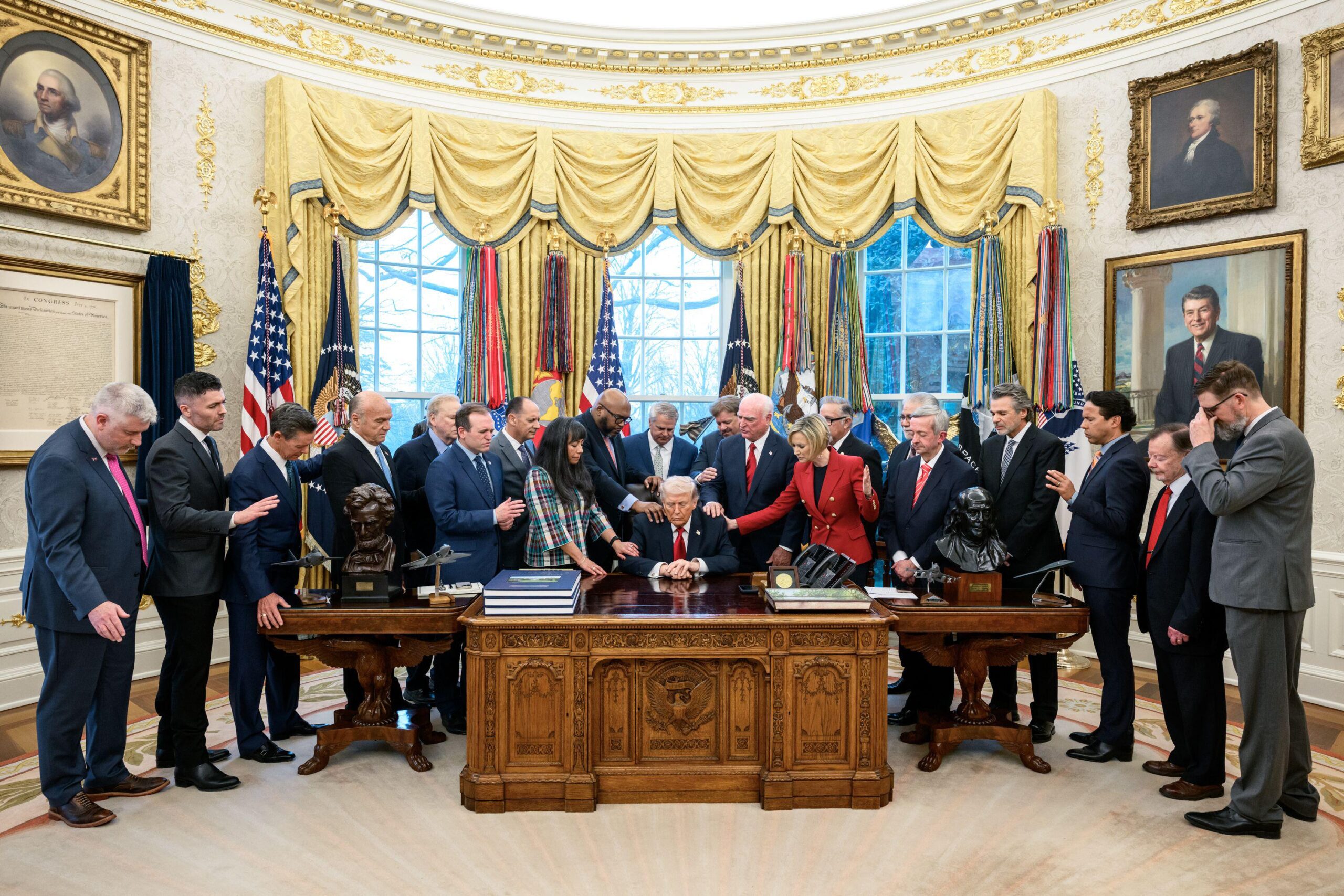
American Photo Archive/Alamy
* * *
Forming political coalitions on the left in the United States of America after 1964 is not an easy task. The latent pan-racial class solidarity that Bernie Sanders believes sits just beneath the surface remains obstinately out of sight. But even beyond racial divisions, America’s default sensibility remains that observed in Steinbeck’s reminisces of the 1930s where the difficulty for communist organizers was that there were no “self-admitted proletarians. Everyone was a temporarily embarrassed capitalist.”[125] Gore Vidal once pegged America as “a sanctimonious society of hustlers,” where “the first law is, “I won’t blow your scam and you don’t blow mine.”[126] And Coolio’s words about street life can be expanded, mutatis mutandis, to American life more broadly: “We keep spending most our lives living in the gangsta’s paradise.”[127] No less a seminal and American intellectual figure than Ralph Waldo Emerson writes in his most influential work that “society everywhere is in conspiracy against the manhood of every one of its members.” He claims that one should not speak to him of his “obligation to put all poor men in good situations,” asking, “are they my poor?” He scoffs at scientific triumphs such as the “advancement of the art of war,” when “Napoleon conquered Europe by the bivouac, which consisted of falling back on naked valor and disencumbering it of all aids.”[128]
Add to this male-coded default outlook of rugged, individual-orientated assays for fortune the racial and cultural divisions that can be easily exploited by the American right, and you have tough sledding for the assembling of left-of-center majority coalitions that ask Americans not just to think of narrow material benefits for themselves, but also accept an expansion of rights and improvement of life for others (that would, the next step goes, improve the broader society in which all Americans live). And yet these majority coalitions are absolutely essential to form, regularly and soon, if America’s actual shining-city-on-a-hill promise (multi-racial democracy) is to become a reality in spite of the current crisis.
Writing in March of 1974, just five months before Richard Nixon would resign under the weight of the Watergate scandal that had begun nearly two years prior, Elizabeth Drew surveyed the way in which the broader culture had responded to the crisis and found very little that was reassuring.
Speaking of Nixon and his henchmen, she noted that the “tough-guy talk of the President’s aides was the very atmosphere of [Nixon’s] White House.”
These people seem to have understood little of what politics and government are supposed to be about. But they had power. And, as they compromised the public morality, they were not alone. There were those who aided and abetted: the businessmen who bought in, went along, and would not speak out; those politicians and members of the press who were truly frightened.[129]
Though one could then see the end of the Nixon crisis on the horizon, Drew wondered about what the response to a future rogue presidency might look like. Having seen up close a president unconstrained by democratic sentiment and institutional guardrails, what could be done to prevent another—even worse—such president in the future.
Drew’s concern was not just about the possibility of another criminal president, but about the numerous cultural and institutional failings she had seen in the country’s response to Nixon. Was there a way to remedy these failings?
In the future…we cannot look to some leader to save us; that would be one of the wrong lessons to draw from this period. Nor can we put our faith in the Congress; the Congress almost failed us, or perhaps it did fail us. We cannot put our faith in new legislation; laws are not self-enforcing. We cannot put our faith in the private sector, because so much of the private sector bought in. We cannot put our faith in the press; the press almost failed us.
Because “not everything can be codified,” Drew felt it incumbent to recognize that “[d]emocracy, like any noncoercive relationship, rests on a shared understanding of limits.” What had been frightening about the Nixon experience was that it had been “with people in power who did not recognize limits.” “In the end,” Drew wrote, “it comes down to us.”[130]
The day before Nixon resigned, Drew wrote that she wondered if future historians would truly understand the times. Would they “be able to understand why, almost two years ago, some very sensible people wondered whether it was the last election?”[131]
Knowing the conclusion, as they will, will they understand how difficult, frightening, and fumbling the struggle really was?[132]
We, not yet knowing the conclusion, would do well to make our own struggles less fumbling.
* * *
The early days of Donald Trump’s return to the Oval Office saw him use the setting to bring in the cameras and sign a series of regressive Executive Orders (each more grotesque than the last),[133] swear in members of his rogue’s gallery cabinet,[134] provide the technology billionaire Elon Musk with a stage from which to announce drastic cuts to the federal workforce,[135] and browbeat Ukrainian President Volodymyr Zelensky over his supposed ingratitude.[136] There was also the meeting with the President of El Salvador, where the imprisonment of a wrongfully deported man in a brutal maximum-security prison in Tecoluca, El Salvador, was celebrated.[137]
In addition to these highlights, Trump also used this time to redecorate the Oval Office, decking it out in gold vases, gold trophies, gold medallions, gilded-framed mirrors, side tables held aloft by gold eagles, and other gold accents such as gold cherubs. One side of the office was filled with gilded-framed portraits of previous presidents. The coffee table between two couches now sported golden coasters.[138] More than a year in, each new day seemed to bring with it more gold accents. Gold script was affixed to the exterior wall of the Oval Office spelling out “The Oval Office.” And of course, Trump’s golden ambitions began to leak out of the Oval Office. As the New York Times reported:
In September [of 2025], Mr. Trump unveiled the “Presidential Walk of Fame” on the West Colonnade, which is the main walkway between the White House’s executive residence and the West Wing. The exhibit displays every president’s portrait, in chronological order, framed in gold with additional gold onlay elements applied above the portraits.
That October he destroyed the old 12,000-square-foot East Wing as part of a plan to create a new 90,000 square-foot East Wing whose centerpiece would be a 22,000-square-foot ballroom complete with an ornate, gold-trimmed ceiling. (In an uncharacteristic show of restraint, Trump’s addition of his name to the Kennedy Center’s façade was not done in gold letters.)[139]
But rather than suggest the kingly setting with which his autocratic ambitions align, the new décor and gold creep suggested something else entirely. Kings of all kinds have had tacky taste. Versailles is famously too much. But Trump’s golden Oval Office rings hollow as an expression of monarchical self-regard—not because it’s a comically garish spectacle of autocratic ambition, but because it’s a florid staging of baubles more suited to a slide in a Zillow listing for a lavish Jupiter Island or West Palm Beach property.
A curious byproduct of America’s revolutionary founding and journey through two and a half centuries of varying degrees of self-governance has been an odd paradox wherein there exists high tolerance and reverence for vast concentrations of wealth in the hands of a small set of individuals while there is simultaneously present an intolerance for aristocratic affectation and aspiration, or more pointedly, an intolerance for the naked claim that a concentration of wealth naturally translates into a right to govern. While vast wealth does afford one an outsized influence in American society (a fact that is lamentably countenanced), it does not automatically afford one a right to an official position of leadership. Hearst had his newspaper empire, and later his castle (mocked as his “Xanadu” by Welles), but in spite of his grand political ambitions that eyed the Presidency, the farthest he got was two undistinguished terms in the House.
In America, the luxurious residences of the vastly wealthy do not read primarily as expressions of political power. They read as expressions of wealth. And wealth has many different aesthetics, whereas authority has only a few; and in America, these aesthetics have not typically been particularly opulent, and certainly not monarchical. The Capitol, the Supreme Court, the National Mall with its various monuments, state governor’s mansions—all are in some way grand, but none is particularly opulent. American legitimacy was figured at the founding as a continuation of the Parthenon’s sapient grandeur, not as a New World House of Bourbon. America’s courtrooms are famously spare and bland. The nation’s business events are held in hotel ballrooms beneath chandeliers made of steel and crystal (not gold and blown glass). The striver’s compound at Hyannis and the restrained WASP retreat in Kennebunkport: both are large but hardly sumptuous and, instructively, both were liabilities to overcome when their respective residents sought the White House.
Because America does not have an agreed-upon, time-impervious language that marries opulence and power, no history of primogeniture or of explicitly being born to rule, efforts to pair the two into a single symbolic whole ring false. Inspired by European monarchical traditions, Nixon briefly outfitted the White House’s security detail in double-breasted, gold-button uniforms complete with gold aiguillettes and gold-trimmed pointed caps. The effort was roundly ridiculed, and Nixon was forced to withdraw them.[140]
The language of extreme wealth in America is therefore an often garish mishmash. Hearst’s castle doesn’t make much sense as a whole but is undeniably lavish. More than that, it is an accumulation—a bric-a-brac of palatial luxury if not refinement. And the ketchup and mustard bottles that rest on the large table in its dining room (inexplicably named the Refectory and modeled on a Medieval monastery’s dining hall) aren’t just a winking nod to the rustic setting of the property; they also serve as a sort of terminus or boundary. No matter the fanciful journey of Old World aristocratic emulation upon which wealth takes one, in America there is no escaping America.
And thus, contemporary American expressions of great wealth can speak in many tongues, but none of them is the symbolic language typically associated with authority in a constitutional democracy founded in opposition to monarchy. The billionaire Larry Ellison owns a vast real estate portfolio (itself an expression of wealth), that includes a former Astor estate in Newport, Rhode Island, built of brick, stucco, limestone, and slate; “98% of the Hawaiian Island of Lanai;” a home in Woodside, California, that is “modeled after a 16th-century Japanese emperor’s palace;” “eleven properties in Malibu’s Carbon Beach;” and the luxuriously dull Eau Palm Beach Resort and Spa in Florida, which Forbes described as “Larry Ellison’s Latest Bauble.”[141]
But beyond unconstrained avarice, there is no readily apparent theme that unifies these properties under a common aesthetic language. The properties speak of wealth, but not necessarily political power, in the same way that Jeff Bezos’ sending his then-fiancé up in a space rocket with a pop music star does.[142]
Trump’s Oval Office effort to match his personal aesthetic of wealth with the nation’s language of authority and power therefore faces hurdles. Trump’s own language of wealth, already deeply compromised by deficiencies in taste, is further stunted by the relative simplicity of the nation’s symbols. The Presidential Seal on a blue flag, the Lincoln Memorial, the Rose Garden (now paved), Air Force One, the Oval Office itself—all are striking and refined; none is particularly opulent. Trump’s efforts to create a kingly redoubt in the Oval Office end up undermining his purpose by evoking nothing more monarchical than the den in a model home for an exclusive luxury subdivision currently under construction in a gated community on Hilton Head.
Perhaps, in time, Trump’s remake of the Oval Office will be seen as the beginning of a process in which the move toward autocracy began to change the national symbolic language of authority itself: the beginning of a kind of aesthetic of what we might call “trashism.” But for now, both Donald Trump and the American populace are confronted by the same stark fact: what you’ve put inside the Oval Office is less evidence of your own power, and more evidence of what you are subject to.
Dan Monaco is Editor of The Straddler.
dmonaco@thestraddler.com
[1] Oscar Wilde, The Picture of Dorian Gray, Vintage Classics, 2011, 37.
[2] Donald Kagan, Pericles of Athens and the Birth of Democracy, The Free Press, 1991, 169.
[3] Reanna Smith and Gavin Quinn, “Donald Trump Accused of Using AI as ‘Glitch’ Spotted in Charlie Kirk Video,” Irish Star, September 11, 2025, https://www.irishstar.com/news/us-news/donald-trump-video-charlie-kirk-35887433.
[4] Raymond Carlson, “9/11 Speech Sparks Dispute,” Yale Daily News, Week in Review, September 10–14, 2007, vol. CXXIX, no. 2.
[5] Kagan, Pericles of Athens, 2-3.
[6] Kagan, Pericles of Athens, 9.
[7] For example, Herman Beck, “Reactionary Nationalism and Fascism: The German Case,” in Reactionary Nationalists, Fascists and Dictatorships in the Twentieth Century: Against Democracy edited by Ismael Saz, Zira Box, Toni Morant, Julián Sanz (Switzerland: Palgrave, 2019) pp. 85-104.
[8] Clay Risen, “Donald Kagan, Leading Historian of Ancient Greece, Dies at 89,” New York Times, August 13, 2021, https://www.nytimes.com/2021/08/13/books/donald-kagan-dead.html; Shay Khatari, “Don Kagan: The Man, the Legend,” The Bulwark, August 12, 2021, https://www.thebulwark.com/p/don-kagan-the-man-the-legend.
[9] Robert Kagan, “This is How Fascism Comes to America,” Washington Post, May 18, 2016, https://www.washingtonpost.com/opinions/this-is-how-fascism-comes-to-america/2016/05/17/c4e32c58-1c47-11e6-8c7b-6931e66333e7_story.html.
[10] Robert Kagan, “A Trump Dictatorship is Increasingly Inevitable. We Should Stop Pretending,” Washington Post, November 30, 2023, https://www.washingtonpost.com/opinions/2023/11/30/trump-dictator-2024-election-robert-kagan/; Robert Kagan, “The Trump Dictatorship: How to Stop It,” Washington Post, December 7, 2024, https://www.washingtonpost.com/opinions/2023/12/07/robert-kagan-trump-dictatorship-how-to-stop/.
[11] “’Premature Capitulation’: WaPo Editor Robert Kagan Resigns in Protest,” MSNBC, October 27, 2024, https://www.msnbc.com/ali-velshi/watch/-premature-capitulation-wapo-editor-robert-kagan-resigns-in-protest-222797381862.
[12] Morning Joe, July 13, 2022, on MSNBC.
[13] Library of Congress, “American Women in the Moving Image: Television,” Library of Congress Research Guides, https://guides.loc.gov/american-women-moving-image/television; TVB Marketing Solutions, “National Television Penetration Trends,” October 2022, https://www.tvb.org/wp-content/uploads/2022/10/National-TV-Household-Penetration-Trends.pdf.
[14] National Archives, “President Dwight D. Eisenhower’s Farewell Address (1961),” Founding Documents, https://www.archives.gov/milestone-documents/president-dwight-d-eisenhowers-farewell-address.
[15] For a brief recent consideration of this history, see Scott Anderson, “When a President Gets Addicted to Regime Change,” New York Times, March 13, 2026, https://www.nytimes.com/2026/03/13/magazine/iran-trump-regime-change-history-eisenhower.html.
[16] Scott Anderson, “When a President Gets Addicted to Regime Change,” New York Times Magazine, March 13, 2026, https://www.nytimes.com/2026/03/13/magazine/iran-trump-regime-change-history-eisenhower.html.
[17] Thomas Friedman, “The Message From Texas Voters: We’re Neighbors, Not Enemies,” The New York Times, February 2, 2026, https://www.nytimes.com/2026/02/02/opinion/columnists/trump-america-identity.html. Emphasis mine.
[18] Dwight D. Eisenhower, “Radio and Television Address to the American People on the Situation in Little Rock,” September 24, 1957, The American Presidency Project, University of California, Santa Barbara, https://www.presidency.ucsb.edu/documents/radio-and-television-address-the-american-people-the-situation-little-rock.
[19] Kruschev’s decision to place nuclear missiles in Cuba was a reckless gamble, but it was not made in a vacuum. America’s paramilitary actions against Cuba and its ongoing threat to invade the island also contributed to the crisis. As did the placement of US missiles in Turkey. But again, the focus here is on the Oval Office as national self-conception.
[20] John F. Kennedy, “Radio and Television Report to the American People on the Soviet Arms Buildup in Cuba,” October 22, 1962, The American Presidency Project, University of California, Santa Barbara, https://www.presidency.ucsb.edu/documents/radio-and-television-report-the-american-people-the-soviet-arms-buildup-cuba.
[21] Lyndon B. Johnson, “The President’s Address to the Nation Announcing Steps To Limit the War in Vietnam and Reporting His Decision Not To Seek Reelection,” March 31, 1968, The American Presidency Project, University of California, Santa Barbara, https://www.presidency.ucsb.edu/documents/the-presidents-address-the-nation-announcing-steps-limit-the-war-vietnam-and-reporting-his.
[22] Richard Nixon, “Address to the Nation Announcing Decision To Resign the Office of President of the United States,” August 8, 1974, The American Presidency Project, University of California, Santa Barbara, https://www.presidency.ucsb.edu/documents/address-the-nation-announcing-decision-resign-the-office-president-the-united-states.
[23] Gerald R. Ford, “Remarks on Signing the Proclamation Granting Pardon to Richard Nixon,” September 8, 1974, The American Presidency Project, University of California, Santa Barbara, https://www.presidency.ucsb.edu/documents/remarks-signing-proclamation-granting-pardon-richard-nixon.
[24] Abraham Lincoln, “Inaugural Address,” March 4, 1861, The American Presidency Project, University of California, Santa Barbara, https://www.presidency.ucsb.edu/documents/inaugural-address-34.
[25] Tom Ginsburg, “Democratic Backsliding and Multiracial Democracy: A Response to the 2021 Jorde Symposium Lecture by Steven Levitsky,” California Law Review 110, no. 6 (December 2022): 2035, https://lawcat.berkeley.edu/record/1258081?v=pdf.
[26] William F. Buckley, A Torch Kept Lit: Great Lives of the Twentieth Century, ed. James Rosen, Crown Forum, 2016, 207. Reprint of William F. Buckley, “Martin Luther King, RIP,” syndicated column, April 8, 1968.
[27] Brian Kennedy, “Most Americans think U.S. K-12 STEM education isn’t above average, but test results paint a mixed picture,” Pew Research Center, April 24, 2024, https://www.pewresearch.org/short-reads/2024/04/24/most-americans-think-us-k-12-stem-education-isnt-above-average-but-test-results-paint-a-mixed-picture/.
[28] Calvin Coolidge, “Address to the American Society of Newspaper Editors, Washington, D.C.,” January, 17, 1925, The American Presidency Project, University of California, Santa Barbara, https://www.presidency.ucsb.edu/documents/address-the-american-society-newspaper-editors-washington-dc.
[29] John Ford, dir., The Searchers (1956, Warner Brothers). Also cited in Peter Wollen, Signs and Meaning in Cinema, Indiana University Press, 1972, 97.
[30] “Democracy is Troublemaking: Lewis Lapham in conversation with The Straddler,” The Straddler, Summer, 2012, https://thestraddler.com/2022/01/01/democracy-is-troublemaking-lewis-lapham-in-conversation-with-the-straddler/.
[31] NBC News, “2024 Election Exit Polls,” NBC News, https://www.nbcnews.com/politics/2024-elections/exit-polls.
[32] Jimmy Carter, “Address to the Nation on Energy and National Goals: ‘The Malaise Speech,’” July 15, 1979, The American Presidency Project, University of California, Santa Barbara, https://www.presidency.ucsb.edu/documents/address-the-nation-energy-and-national-goals-the-malaise-speech.
[33] Ronald Reagan, “Address to the Nation on the Economy, February 5, 1981,” Ronald Reagan Presidential Library, https://www.reaganlibrary.gov/archives/speech/address-nation-economy-february-1981.
[34] Although Obama delivered one from a podium in front of his desk.
[35] CNBC Television, “Watch President Donald Trump’s address to the nation on coronavirus pandemic,” YouTube video, 9:45, March 12, 2020, https://www.youtube.com/watch?v=xrPZBTNjX_o.
[36] Lewis, Sinclair. It Can’t Happen Here, Signet Classics, p. 358. Kindle Edition.
[37] Lewis, It Can’t Happen Here, 42-43.
[38] Lewis, It Can’t Happen Here, 30.
[39] Lewis, It Can’t Happen Here, 50, 71-73.
[40] Pew Research Center, An Examination of the 2016 Electorate, Based on Validated Voters, August 9, 2018, https://www.pewresearch.org/politics/2018/08/09/an-examination-of-the-2016-electorate-based-on-validated-voters/.
[41] Trump’s famous literal hugging of the flag was a characteristic overcompensation for a lack of such bonds.
[42] ABC Television Network, “Press Release,” “I. T. R. S. RANKING REPORT 01 THRU 210 (OUT OF 210 PROGRAMS) DAYPART: PRIMETIME MON-SUN,” June 2, 2004, archived at The Internet Archive’s Wayback Machine https://web.archive.org/web/20070930155240/http://www.abcmedianet.com/Web/progcal/dispDNR.aspx?id=060204_11; “TV Show Ranking 2006-2007 Season USA,” Mindy TV Blog, September 2007, https://mindy-tv.blogspot.com/2007/09/tv-show-ranking-2006-2007-season-usa.html.
[43] This revamping gave the series new life, with the first season of Celebrity Apprentice (the seventh of the Apprentice franchise) ranking 48th overall with 11 million viewers. But as with the first incarnation of the show, Celebrity Apprentice did not have staying power. Josef Adalian, “The Celebrity Apprentice Ratings Haven’t Been Great for a Long, Long Time,” Vulture, January 6, 2017, https://www.vulture.com/2017/01/celebrity-apprentice-ratings-were-down-for-years.html. Trump began vocally supporting the conspiracy about Barack Obama’s birth certificate in the spring of 2011, but it wasn’t until he’d put up three straight seasons of dud ratings that NBC sanctimoniously decided to “fire” him in June of 2015—supposedly because of derogatory comments he’d made about Mexicans.
[44] Dan Primack, “5 Worst Internet Acquisitions of All Time,” Fortune, May 21, 2013, https://fortune.com/2013/05/21/5-worst-internet-acquisitions-of-all-time/.
[45] Kaili Kirkpatrick, “Mark Cuban Admits: ‘I’ve Gotten Beat’ After Losing $20 Million On Shark Tank Startups,” Yahoo Finance, December 20, 2024, https://finance.yahoo.com/news/mark-cuban-admits-ive-gotten-144518372.html.
[46] This is of a piece with the enrichment ethos of Silicon Valley pikers, which says if you can come up with something semi-plausible your startup might get bought out for millions in spite of the fact that it has no real business future.
[47] Douglas Quenqua, “Another Trump Hopes What Glitters Will Be Gold,” New York Times, April 15, 2010, https://www.nytimes.com/2010/04/16/business/media/16adco.html.
[48] Karyn L. Barr, “‘Apprentice’ Stars Sell Out on QVC,” Entertainment Weekly, October 22, 2004, https://ew.com/article/2004/10/22/apprentice-stars-sell-out-qvc/.
[49] QVC, “As‑Is Bethlehem Lights 11″ Micro‑LED Christmas Tree,” QVC product page, accessed June 20, 2025, https://www.qvc.com/as-is-bethlehem-lights-11-micro-led-christmas-tree.product.H449835.html.
[50] Michelle Ruiz, “Gwyneth’s World,” Vanity Fair, April 2025 issue, https://www.vanityfair.com/hollywood/story/gwyneth-paltrow-2025-interview.
[51] Jon C. Tilburt, Megan Allyse, and Frederic W. Hafferty, “The Case of Dr. Oz: Ethics, Evidence, and Does Professional Self‑Regulation Work?” AMA Journal of Ethics 19, no. 2 (February 2017): 199–206, https://doi.org/10.1001/journalofethics.2017.19.2.msoc1-1702; “Dr. Oz Prescribes $5.25M Settlement in False Ad Case,” Manatt, Phelps & Phillips, LLP, July 12, 2018, https://www.manatt.com/insights/newsletters/advertising-law/dr-oz-prescribes-5-25m-settlement-in-false-ad-cas; Kate Sullivan and Alayna Treene, “Trump Names Dr. Mehmet Oz to Lead Centers for Medicare and Medicaid Services,” CNN Politics, November 19, 2024, https://www.cnn.com/2024/11/19/politics/mehmet-oz-trump-medicare-medicaid.
[52] TMZ, “Psychology Board Investigates Dr. Phil,” TMZ, January 16, 2008, https://www.tmz.com/2008/01/16/psychology-board-investigates-dr-phil/; Silvia Mignon, “Dr. Phil McGraw: The Questionable Methods of Daytime Television” in Social Work and Mental Health: Evidence-Based Policy and Practice, Springer Publishing Company, 2020, 103-4.
[53] OWN, “Donald Trump: ‘There’s No More Important Word Than ‘Luck’ | The Oprah Winfrey Show | OWN,” YouTube video, March 19, 2016, https://web.archive.org/web/20201215222909/http://www.youtube.com/watch?v=1-SEMV_leAE.
[54] OWN, “Living the Trump Life: ‘I’ve Got What I Want, and I Love What I Do’ | The Oprah Winfrey Show | OWN,” YouTube video, April 12, 2016, https://www.youtube.com/watch?v=yP5rDRZmboM&pp=ygUKb3ByYWggMTk4OA%3D%3D.
[55] OWN, “Why Donald Trump Jr. Doesn’t Like Using the Trump Name | The Oprah Winfrey Show | OWN,” YouTube video, April 12, 2016, https://web.archive.org/web/20250729182710/http://www.youtube.com/watch?v=vDGEbJ1VVQg.
[56] OWN, “Donald Trump on Oprah’s ‘It’ Factor | The Oprah Winfrey Show | Oprah Winfrey Network,” YouTube video, December 8, 2015, https://web.archive.org/web/20251104155021/https://www.youtube.com/watch?v=CsHTXzDf-oc.
[57] Michael Major, “Photo: Lin-Manuel Miranda & Andrew Lloyd Webber Guest Judge at CATS: THE JELLICLE BALL,” BroadwayWorld, April 9, 2026, https://www.broadwayworld.com/article/Photo-Lin-Manuel-Miranda-Andrew-Lloyd-Webber-Guest-Judge-at-CATS-THE-JELLICLE-BALL-20260409.
[58] A broader selection of “turning point” dates might include the April 1945 death of Franklin Delano Roosevelt (at the tail end of the war); the November 1952 landslide election of Dwight D Eisenhower as the Democratic incumbent Harry Truman declined to seek reelection while facing high-20s/low-30s approval ratings amidst a stalemate in Korea and a Red Scare at home; the November 1963 assassination of John F Kennedy; Humphrey’s November 1968 loss to Nixon; Carter’s November 1980 loss to Reagan; Barack Obama’s victories in November 2008 and 2012; the passage of the Affordable Care Act in March of 2010; Joe Biden’s win over Donald Trump in 2020; and Kamala Harris’ loss to Donald Trump in November 2024.
[59] AP, “Defense Official Calls Goldwater’s View on Weapons ‘Perilous’,” The New York Times, August 28, 1964, https://www.nytimes.com/1964/08/28/archives/defense-official-calls-goldwaters-view-on-weapons-perilous.html; “139 Scholars Urge Goldwater Defeat,” The New York Times, October 25, 1964, https://www.nytimes.com/1964/10/25/archives/139-scholars-urge-goldwater-defeat.html; Library of Congress, “‘Daisy’ Ad (1964): Preserved from 35mm in the Tony Schwartz Collection,” YouTube video, September 7, 2016, http://www.youtube.com/watch?v=riDypP1KfOU; Tom Wicker, “Convention ends: Extremism in Defense of Liberty ‘No Vice,’ Arizonan Asserts,” The New York Times, July 17, 1964, https://www.nytimes.com/1964/07/17/archives/convention-ends-extremism-in-defense-of-liberty-no-vice-arizonan.html.
[60] Roper Center for Public Opinion Research, How Groups Voted in 1976, Cornell University, https://ropercenter.cornell.edu/how-groups-voted-1976.
[61] Jonathan Alter, “When Jimmy Carter Was Silent on Civil Rights,” Wall Street Journal, September 18, 2020, https://www.wsj.com/articles/when-jimmy-carter-was-silent-on-civil-rights-11600437234.
[62] Jimmy Carter [D-GA] 1976 Campaign Ad “Welfare”, YouTube video, 0:31, posted by Carl Albert Congressional Research and Studies Center, March 26, 2020, https://www.youtube.com/watch?v=ULsDQWLD_SQ. https://www.youtube.com/watch?v=ULsDQWLD_SQ.
[63] 1976 Carter Mondale Campaign Ad, YouTube video, posted by davek70s, October 27, 2011, https://www.youtube.com/watch?v=4VpTaVf_vNo.
[64] Josh Zeitz, “The Worst Way to Stop a Front-Runner,” Politico Magazine, May 3, 2016, https://www.politico.com/magazine/story/2016/05/what-nevertrump-can-learn-from-anybody-but-carter-213860/.
[65] Roper Center for Public Opinion Research, How Groups Voted in 1980, Cornell University, https://ropercenter.cornell.edu/how-groups-voted-1980.
[66] Roper Center for Public Opinion Research, How Groups Voted in 1984, Cornell University, https://ropercenter.cornell.edu/how-groups-voted-1984.
[67] Roper Center for Public Opinion Research, How Groups Voted in 1988, Cornell University, https://ropercenter.cornell.edu/how-groups-voted-1988.
[68] The Campaign Ad That Reshaped Criminal Justice, The Takeaway, produced by WNYC Studios, May 18, 2015, podcast, https://www.wnycstudios.org/podcasts/takeaway/segments/crime-reshaped-criminal-justice.
[69] Marshall Ingwerson, “Polls and History Begin to Deal Kindly with Jimmy Carter,” Christian Science Monitor, July 19, 1988, https://www.csmonitor.com/1988/0719/acart.html.
[70] Rick Perlstein, “Exclusive: Lee Atwater’s Infamous 1981 Interview on the Southern Strategy,” The Nation, November 13, 2012, https://www.thenation.com/article/archive/exclusive-lee-atwaters-infamous-1981-interview-southern-strategy/.
[71] Clinton-Gore 1992 Campaign Ad, YouTube video, posted by kyle, September 4, 2016, https://www.youtube.com/watch?v=R1rS9R-uNiY.
[72] Jack Nelson and David Lauter, “Clinton Vows to Rebuild U.S.; Bush Warns of ‘Misery Index’: Debate: Perot Says Neither of His Rivals’ Economic Plans Would Work. He Charges Bush Foreign Policy Helped Create Hussein in Iraq and Noriega in Panama,” Los Angeles Times, October 20, 1992, https://www.latimes.com/archives/la-xpm-1992-10-20-mn-405-story.html.
[73] Cathleen Decker, “Clinton, Gore Evoke Imagery of the Kennedys,” Los Angeles Times, July 20, 1992, https://www.latimes.com/archives/la-xpm-1992-07-20-mn-4079-story.html.
[74] Roper Center for Public Opinion Research, How Groups Voted in 1992, Cornell University, https://ropercenter.cornell.edu/how-groups-voted-1992.
[75] Conor Burns, “Margaret Thatcher’s Greatest Achievement: New Labour,” ConservativeHome (blog), April 11, 2008, https://web.archive.org/web/20200102015714/https://conservativehome.blogs.com/centreright/2008/04/making-history.html.
[76] Bill Clinton, “Address Before a Joint Session of the Congress on the State of the Union,” The American Presidency Project, January 23, 1996, https://www.presidency.ucsb.edu/documents/address-before-joint-session-the-congress-the-state-the-union-10.
[77] U.S. House of Representatives, “Roll Call Vote 575, On Passage, H.R. 3450: North American Free Trade Agreement Implementation Act,” Office of the Clerk, November 17, 1993, https://clerk.house.gov/Votes/1993575; U.S. Senate, “Roll Call Vote 395 – On Passage of the Bill (H.R. 3450: North American Free Trade Agreement Implementation Act),” 103rd Cong., 1st sess., November 20, 1993, U.S. Senate Roll Call Votes, Vote 395, https://www.senate.gov/legislative/LIS/roll_call_votes/vote1031/vote_103_1_00395.htm.
[78] Economic Policy Institute, “Explaining the Erosion of Private‑Sector Unions: How Corporate Practices and Legal Changes Have Undercut the Ability of Workers to Organize and Bargain,” Unequal Power (blog/report), https://www.epi.org/unequalpower/publications/private-sector-unions-corporate-legal-erosion/.
[79] Peter Perl, “AFL‑CIO Chief Blasts Reagan, Democrats, NLRB,” The Washington Post, October 29, 1985, https://www.washingtonpost.com/archive/politics/1985/10/29/afl-cio-chief-blasts-reagan-democrats-nlrb/f5d8231a-5081-4f44-befc-ca526cad9ba3/.
[80] It Has Become a National Anti‑Labor Relations Board,” Chicago Tribune, April 6, 1988, https://www.chicagotribune.com/news/ct-xpm-1988-04-06-8803060628-story.html.
[81] Thomas B. Edsall, “Are Labor Tactics on NAFTA Real Threats or ‘Tough Love’?” The Washington Post, November 16, 1993, A24, https://www.washingtonpost.com/archive/politics/1993/11/16/are-labor-tactics-on-nafta-real-threats-or-tough-love/e9fcf407-c1d5-40cc-a491-1f3e1017ff6b/; Keith Bradsher, “Clinton Offers Job Training for Trade‑Pact Casualties,” The New York Times, October 14, 1993, https://www.nytimes.com/1993/10/14/us/clinton-offers-job-training-for-trade-pact-casualties.html.
[82] Roper Center for Public Opinion Research, “How Groups Voted in 1996,” Roper Center for Public Opinion Research, https://ropercenter.cornell.edu/how-groups-voted-1996.
[83] Juliet Eilperin and Dana Milbank, “Clinton Eyed Private Social Security Accounts,” The Washington Post, June 29, 2001, https://www.washingtonpost.com/archive/politics/2001/06/29/clinton-eyed-private-social-security-accounts/40b63c9a-b3c2-416c-b30b-7986fe0c2389/.
[84] Patricia Mazzei, “Jeb Bush’s Inclusive Message to Face Tough Test before African Americans,” Tampa Bay Times, July 29, 2015, https://www.tampabay.com/news/politics/national/jeb-bushs-inclusive-message-to-face-tough-test-before-african-americans/2239288/.
[85] U.S. Commission on Civil Rights, Voting Irregularities in Florida During the 2000 Presidential Election: Executive Summary, June 2001, https://www.usccr.gov/files/pubs/vote2000/report/exesum.htm.
[86] U.S. Senate, Roll Call Vote 102nd Congress – 1st Session, Vote Number 2, January 12, 1991, https://www.senate.gov/legislative/LIS/roll_call_votes/vote1021/vote_102_1_00002.htm.
[87] Cathleen Decker, “Bush Targets Clinton’s Gulf War Stance: Politics: Campaign Cites 1991 Statements by the Democratic Nominee That He Agreed with Lawmakers Who Favored Sanctions over Military Action,” Los Angeles Times, July 31, 1992, https://www.latimes.com/archives/la-xpm-1992-07-31-mn-4566-story.html.
[88] George C. Herring, “America and Vietnam: The Unending War,” Foreign Affairs, 70, no. 5 (December 1991): 104–118, https://www.foreignaffairs.com/articles/vietnam/1991-12-01/america-and-vietnam-unending-war.
[89] Commission on Presidential Debates, “October 19, 1992 Debate Transcript,” October 19, 1992, https://www.debates.org/voter-education/debate-transcripts/october-19-1992-debate-transcript/.
[90] U.S. Senate, “Roll Call Vote 107th Congress – 2nd Session, Vote Number 237,” October 11, 2002, https://www.senate.gov/legislative/LIS/roll_call_votes/vote1072/vote_107_2_00237.htm.
[91] Senator Obama talks about Hillary Clinton’s position on Iraq war, YouTube video, posted by AP Archive, July 21, 2015, https://www.youtube.com/watch?v=R1rS9R-uNiY.
[92] Alex Thompson, “‘The President Was Not Encouraging’: What Obama Really Thought About Biden,” Politico Magazine, August 14, 2020, https://www.politico.com/news/magazine/2020/08/14/obama-biden-relationship-393570.
[93] Michael D. Shear, “Neera Tanden, a Clinton Ally, Gave Campaign Candid Advice in Private Emails,” The New York Times, October 30, 2016, https://www.nytimes.com/2016/10/30/us/politics/neera-tanden-wikileaks.html.
[94] Nick Gass, “Clinton: ‘I Am Not a Natural Politician,’” Politico, March 9, 2016, https://www.politico.com/blogs/2016-dem-primary-live-updates-and-results/2016/03/hillary-clinton-i-am-not-a-natural-politician-220544.
[95] Alex Seitz-Waltz, “Hillary Clinton Struggles to Explain $600K in Goldman Sachs Speaking Fees,” NBC News, February 4, 2016, https://www.nbcnews.com/politics/2016-election/hillary-clinton-struggles-explain-600k-goldman-sachs-speaking-fees-n511041.
[96] Matt Bai, “Obama vs. Boehner: Who Killed the Debt Deal?” New York Times Magazine, April 1, 2012, https://www.nytimes.com/2012/04/01/magazine/obama-vs-boehner-who-killed-the-debt-deal.html.
[97] “For Whom and For What: The Birth of the Republican Party and the Makings of Modern America,” The Straddler, fall2015, https://thestraddler.com/2023/05/02/for-whom-and-for-what-the-birth-of-the-republican-party-and-the-makings-of-modern-america/; David McCullough, “Madness,” in The Greater Journey: Americans in Paris, 303-330, Simon and Schuster, 2011.
[98] Amy Chozick, “In Evoking Good of ’90s, Clinton Risks Memories of the Bad,” The Wall Street Journal, April 30, 2008, https://www.wsj.com/articles/SB120951820890054881.
[99] CNN, “Transcript—CNN Hosts Democratic Debate (Segment 01),” CNN, July 30, 2019, https://transcripts.cnn.com/show/se/date/2019-07-30/segment/01.
[100] CNN, “Transcript—CNN Hosts Democratic Debate.”
[101] Allan Smith, “Sanders Draws Line between Himself and Warren: A ‘Capitalist to Her Bones,’” NBC News Politics, October 13, 2019, https://www.nbcnews.com/politics/2020-election/sanders-draws-line-between-himself-warren-capitalist-her-bones-n1065526.
[102] Rev, “Transcript of July Democratic Debate 2nd Round, Night 2: Full Transcript July 31, 2019,” Rev.com, July 31, 2019, https://www.rev.com/transcripts/transcript-of-july-democratic-debate-2nd-round-night-2-full-transcript-july-31-2019.
[103] Bernie Sanders (@BernieSanders), “I’ve got news for the Republican establishment. I’ve got news for the Democratic establishment. They can’t stop us.” Twitter, February 22, 2020, 1:02 a.m., https://twitter.com/BernieSanders/status/1231021453270769664.
[104] CBS News, “Bernie Sanders: The 60 Minutes Interview,” 60 Minutes, aired February 23, 2020, video, https://www.cbsnews.com/video/bernie-sanders-democratic-presidential-candidate-anderson-cooper-60-minutes-2020-02-23/.
[105] Gregory Krieg and Eric Bradner, “Bernie Sanders Faces Pivotal Clash as Democratic Establishment Joins Forces Against Him,” CNN, March 3, 2020, https://web.archive.org/web/20250411195708/https://edition.cnn.com/2020/03/03/politics/biden-vs-sanders-super-tuesday/index.html.
[106] Zack Beauchamp, “What the Bernie Sanders’s 2020 Defenders Get Wrong — and Right,” Vox, May 1, 2020, https://www.vox.com/policy-and-politics/2020/5/1/21239019/bernie-sanders-electoral-politics-socialism.
[107] Emma Green, “Bernie Sanders’s Most Vocal Supporter Lets Loose,” The Atlantic, April 23, 2020, https://www.theatlantic.com/politics/archive/2020/04/bernie-sanders-briahna-joy-gray/610378/; Steve Peoples, “AP Interview: Sanders Says Opposing Biden Is ‘Irresponsible,’” AP News, April 14, 2020, https://apnews.com/article/donald-trump-ap-top-news-elections-joe-biden-politics-a1bfb62e37fe34e09ff123a58a1329fa; Hosting a podcast, she asked none other than the Left’s distinguished emeritus Noam Chomsky why we shouldn’t “value our votes enough to arguably withhold them at some point under some conditions,” to which Chomsky responded that “we live in this world, not some world we’d like to imagine. In this world the choice on November 3rd is do we support someone who is a major threat to our existence, or do we throw him out and continue to work on the things that we want to achieve. That is the choice.” CHOMSKY DEBATE VIDEO Bad Faith Podcast OFFICIAL, YouTube video, 50:08, posted by Bad Faith, November 2, 2020, https://www.youtube.com/watch?v=UnKKm5vh3pk.
[108] Edward-Isaac Dovere, “Bernie Sanders Promised Civility. Then He Hired a Twitter Attack Dog,” The Atlantic, March 21, 2019, https://www.theatlantic.com/politics/archive/2019/03/sanders-promised-civility-hired-twitter-attack-dog/585259/.
[109] Armin Rosen, “The Apotheosis of Chapo Trap House,” Tablet Magazine, March 2, 2020, https://www.tabletmag.com/sections/news/articles/the-apotheosis-of-chapo-trap-house.
[110] Megan Messerly, “Culinary Union Officials Face Profanity-Laced Attacks After Scorecard Says Sanders Would ‘End’ Their Health Care,” The Nevada Independent, February 14, 2020, https://thenevadaindependent.com/article/culinary-union-officials-face-profanity-laced-attacks-after-scorecard-says-sanders-would-end-their-health-care.
[111] Daniel Marans, “Alexandria Ocasio-Cortez Refused To Campaign More For Bernie Sanders,” HuffPost, March 13, 2020, https://www.huffpost.com/entry/alexandria-ocasio-cortez-bernie-sanders-campaign-rallies_n_5e6ade51c5b6bd8156f44356; When the general election came down to Biden and Trump, Rogan said he’d “rather vote for Trump.” In the end, he claimed to have voted the Libertarian candidate. When Rogan later became a Covid vaccine skeptic and quack medicine proponent, it caused some minor controversy but did not disturb the brand, which lucratively thrives to this day. By 2024, Rogan had unsurprisingly become an outright Trump supporter. Tom Lutz, “Joe Rogan Would ‘Rather Vote for Trump than Biden’ after Endorsing Sanders,” The Guardian, April 4, 2020, https://www.theguardian.com/us-news/2020/apr/04/joe-rogan-donald-trump-joe-biden-bernie-sanders; Jenni Fink, “Is Joe Rogan a Trump Supporter? Who He Voted for in 2020,” Newsweek, October 22, 2024, https://www.newsweek.com/joe-rogan-trump-supporter-politics-election-vote-1973111; Linda Geddes, “Joe Rogan’s Covid Claims: What Does the Science Actually Say?,” The Guardian, January 31, 2022, updated February 1, 2022, https://www.theguardian.com/culture/2022/jan/31/joe-rogan-covid-claims-what-does-the-science-actually-say; Alayna Treene and Kate Sullivan, “Joe Rogan Endorses Trump on Eve of the Election,” CNN, November 5, 2024, https://www.cnn.com/2024/11/04/politics/joe-rogan-trump-endorsement/index.html.
[112] David A. Graham, “The Night Socialism Went Mainstream,” The Atlantic, February 12, 2020, https://www.theatlantic.com/politics/archive/2020/02/bernie-sanders-wins-new-hampshire/606022/.
[113] Bernie Sanders (@berniesanders), “I do not believe that most of the people who are thinking about voting for Mr. Trump are racist or sexist. Some are, but I think most are people who are hurting, they’re worried about their kids, they’re working longer hours for lower wages. Our job is to reach out to Trump voters to tell them that we’re going to create an economy that works for all of us, not just a few,” X (formerly Twitter), November 5, 2016, https://x.com/berniesanders/status/794941635931099136; Bernie Sanders (@BernieSanders), “Some are, but I think most are people who are hurting, they’re worried about their kids, they’re working longer hours for lower wages,” X (formerly Twitter), November 5, 2016, https://x.com/BernieSanders/status/794941762502610944; Bernie Sanders (@BernieSanders), “Our job is to reach out to Trump voters to tell them that we’re going to create an economy that works for all of us, not just a few,” X (formerly Twitter), November 5, 2016, https://x.com/berniesanders/status/794942125003698176.
[114] Bernie Sanders, “Democrats Must Choose: The Elites or the Working Class,” op‑ed, The Boston Globe, November 10, 2024, https://www.bostonglobe.com/2024/11/10/opinion/democratic-party-working-class-bernie-sanders/.
[115] Lewis, It Can’t Happen Here, 157.
[116] Paul Taylor and D’Vera Cohn, “A Milestone En Route to a Majority Minority Nation,” Pew Research Center, November 7, 2012, https://www.pewresearch.org/social-trends/2012/11/07/a-milestone-en-route-to-a-majority-minority-nation/; Cheyanne M. Daniels, “Multicultural Americans to Become Majority Population by 2050: Report,” The Hill, January 17, 2024, https://thehill.com/homenews/4412311-multicultural-americans-majority-population-2050/.
[117] Bill Moyers, Moyers on America: A Journalist and His Times, The New Press, 2015, 167. Kindle edition.
[118] Michelle Alexander, The New Jim Crow, The New Press 2012, p. 191.
[119] Paul Meara, “Bernie Sanders: Obama Getting 10 Percent of the White Vote in Mississippi Speaks to the ‘Bad Work’ by Democrats,” BET, January 18, 2020, https://www.bet.com/article/uyzibn/bernie-sanders-rips-dems-over-obama-s-low-numbers-in-miss; u/km816, “Black, Aziz, Anansi — A lot of y’all know I am not …,” r/Enough_Sanders_Spam, Reddit, December 5, 2019, https://www.reddit.com/r/Enough_Sanders_Spam/comments/e6b3up/black_aziz_anansi_a_lot_of_yall_know_i_am_not/.
[120] Michael Hiltzik, “A Lengthy List of Trump’s Disastrous Business Deals — Compiled by His Newest Business Partners,” Los Angeles Times, May 18, 2022, https://www.latimes.com/business/story/2022-05-18/trump-business-partners-outline-his-failed-deals.
[121] Aimee Picchi, “Trump $354 Million Fraud Verdict Includes New York Business Ban for 3 Years. Here’s What to Know,” CBS News, February 16, 2024, https://www.cbsnews.com/news/trump-trial-fraud-verdict-trump-organization-impact/.
[122] Peter Sagal, “The End Will Come for the Cult of MAGA,” The Atlantic, August 15, 2023, https://www.theatlantic.com/ideas/archive/2023/08/trumpism-maga-cult-republican-voters-indoctrination/675173/; Jennifer Rubin, “The Media’s Worst Lapse: Refusing to Identify Trump as a Cult Leader,” The Washington Post, January 12, 2024, https://www.washingtonpost.com/opinions/2024/01/12/media-trump-cult/; Joshua Zeitz, “History Shows a Trump Personality Cult Will End in One of Two Ways,” Politico Magazine, April 16, 2022, https://www.politico.com/news/magazine/2022/04/16/history-shows-trump-personality-cult-end-00024941; Jeff Sharlet, “Inside the Cult of Trump: His Rallies Are Church and He Is the Gospel,” Vanity Fair, June 18, 2020, https://www.vanityfair.com/news/2020/06/inside-the-cult-of-trump-his-rallies-are-church-and-he-is-the-gospel; H. Steven Moffic, “The Cult of Trump: A Leading Cult Expert Explains How the President Uses Mind Control,” Psychiatric Times, October 2, 2020, https://www.psychiatrictimes.com/view/cult-trump-leading-cult-expert-explains-how-president-uses-mind-control; David Smith, “Trump’s ‘cult-like control’ of Republican party grows stronger since insurrection,” The Guardian, January 5, 2022, https://www.theguardian.com/us-news/2022/jan/05/donald-trump-republican-party-capitol-attack-insurrection.
[123] Sigmund Freud, Totem and Taboo, W.W. Norton and Company, 1990, 55.
[124] Freud, Totem and Taboo, 56. Emphasis mine.
[125] John Steinbeck, America and Americans and Selected Nonfiction, edited by Susan Shillinglaw and Jackson J. Benson, (Viking, 2002), 27. Kindle Edition.
[126] American Masters: The Education of Gore Vidal, directed by Deborah Dickson (PBS, 2003). https://www.pbs.org/wnet/americanmasters/gore-vidal-about-gore-vidal/2179/.
[127] “Gangsta’s Paradise,” performed by Coolio featuring L.V., on Gangsta’s Paradise (Tommy Boy Records, 1995), Apple Music.
[128] Ralph Waldo Emerson, The Essential Writings of Ralph Waldo Emerson, edited by Brooks Atkinson, (Modern Library, 2000), 134-135, 152.
[129] Elizabeth Drew, Washington Journal: Reporting Watergate and Richard Nixon’s Downfall, Overlook Duckworth, Peter Mayer Publishers, Inc., 2014, 180.
[130] Drew, Washington Journal, 181.
[131] Drew, Washington Journal, 410.
[132] Drew, Washington Journal, 411.
[133] The White House, “Executive Orders,” https://www.whitehouse.gov/presidential-actions/executive-orders/.
[134] The American Presidency Project, “Remarks at a Swearing-in Ceremony for Pamela J. Bondi as Attorney General,” February 5, 2025, https://www.presidency.ucsb.edu/documents/remarks-swearing-ceremony-for-pamela-j-bondi-attorney-general-and-exchange-with-reporters; Office of the Director of National Intelligence, “Intelligence Community Welcomes Tulsi Gabbard as Director of National Intelligence,” February 12, 2025, https://www.dni.gov/index.php/newsroom/press-releases/press-releases-2025/4050-pr-01-25.
[135] The White House, “President Trump Attends Swearing-In of Commerce Secretary Howard Lutnick,” February 21, 2025, https://www.whitehouse.gov/gallery/president-trump-attends-swearing-in-of-commerce-secretary-howard-lutnick; U.S. Department of Health and Human Services, “Robert F. Kennedy, Jr. Sworn in as 26th Secretary at HHS, President Trump Signs Executive Order to Make America Healthy Again,” February 13, 2025, https://www.hhs.gov/press-room/eo-maha.html.
[136] CBS News, “Elon Musk defends DOGE in Oval Office as Trump orders agencies to comply with cuts,” February 12, 2025, https://www.cbsnews.com/news/elon-musk-trump-doge-cuts/.
[137] “What Trump and Zelenskyy said during their heated argument in the Oval Office,” PBS NewsHour, February 28, 2025, https://www.pbs.org/newshour/politics/what-trump-and-zelenskyy-said-during-their-heated-argument-in-the-oval-office.
[138] “Trump, El Salvador president indicate no intention of returning mistakenly deported man,” April 14, 2025, PBS NewsHour, https://www.pbs.org/newshour/show/trump-el-salvadors-president-indicate-no-intention-of-returning-man-mistakenly-deported.
[139] Joe Sommerlad, “Trump has completely transformed the Oval Office – with gold ‘everywhere’,” The Independent, March 17, 2025, https://www.independent.co.uk/news/world/americas/us-politics/trump-oval-office-white-house-decoration-b2716688.html; Jesus Mesa, “Gold Everywhere: See How Donald Trump Has Blinged Out the Oval Office,” Newsweek, March 17, 2025, https://www.newsweek.com/donald-trump-oval-office-gold-2045930; Raven Brunner, “Trump Called Up His ‘Gold Guy’ to Give the White House a Mar-a-Lago Makeover,” PEOPLE, April 21, 2025, https://people.com/donald-trump-flew-in-gold-guy-white-house-makeover-11718960.
[140] “Pomp and Circumstance,” Richard Nixon Museum and Library, October 19, 2021, https://www.nixonlibrary.gov/news/pomp-and-circumstance.
[141] Jeff Vasishta, “Oracle’s Larry Ellison Has Just Bought A London Townhouse For $202 Million To Add To His Global Property Portfolio,” Yahoo Finance, January 15, 2025, https://finance.yahoo.com/news/oracles-larry-ellison-just-bought-164518193.html; “Residential – Larry Ellison Woodside Home,” Airfloor Inc., https://www.airfloor.com/project/residential-larry-ellison-woodside-home/; Suzanne Rowan Kelleher, “Larry Ellison’s Newest Bauble: A Palm Beach Resort 7 Miles From Mar-A-Lago,” Forbes, August 13, 2024, https://www.forbes.com/sites/suzannerowankelleher/2024/08/13/larry-ellison-palm-beach-resort-mar-a-lago/.
[142] Marina Hyde, “What’s more vacuous than an endless vacuum? It’s Lauren Sánchez and Katy Perry’s party in space,” The Guardian, April 15, 2025, https://www.theguardian.com/commentisfree/2025/apr/15/lauren-sanchez-katy-perry-space-blue-origin-female-flight.